Destination eSIMs
Best eSIMs for Thailand Travel: The Smart Pick Before You Land
Find the best esim for thailand travel with practical picks for Saily, Nomad, Airalo, setup timing, data needs, and roaming pitfalls.
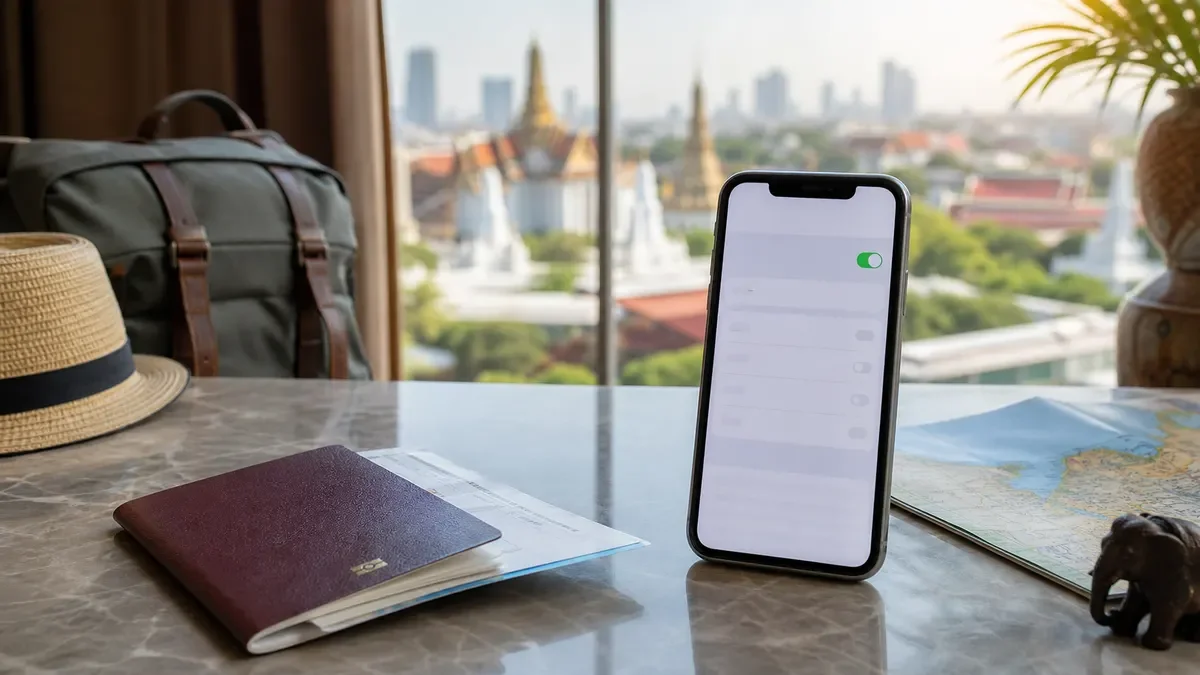
If you are searching for the best esim for thailand travel, start with your trip length and data habits, not the provider with the loudest discount banner. For most visitors, Saily is the easiest value pick, Nomad is strong when you want generous data or hotspot flexibility, and Airalo remains a familiar backup if you already use its app.
Thailand is one of the easier countries for travel connectivity, but the wrong eSIM can still annoy you at the worst moment. Bangkok hotel Wi-Fi is one thing. Finding a Grab pickup zone at Suvarnabhumi, translating a menu in Chiang Mai, or calling your guesthouse on an island is another.
| What you see | Likely cause | First move |
|---|---|---|
| Plan looks cheap, but tiny | Low data allowance | Compare price per GB and validity |
| Unlimited plan sounds vague | Daily high-speed cap or throttling | Read the fair-use notes before buying |
| QR code will not install | Locked or non-compatible phone | Check device support before checkout |
| No data after landing | Wrong data line or roaming toggle | Select the travel eSIM for cellular data |
| Island speed drops | Local network congestion or weak coverage | Try manual network selection if allowed |
The best esim for thailand travel if you want one clear pick
Pick Saily if you want a simple prepaid data plan for Bangkok, Phuket, Chiang Mai, and typical tourist routes. Its Thailand page lists small fixed plans for light users and larger 30-day options, which makes it easier to avoid overbuying for a short trip.
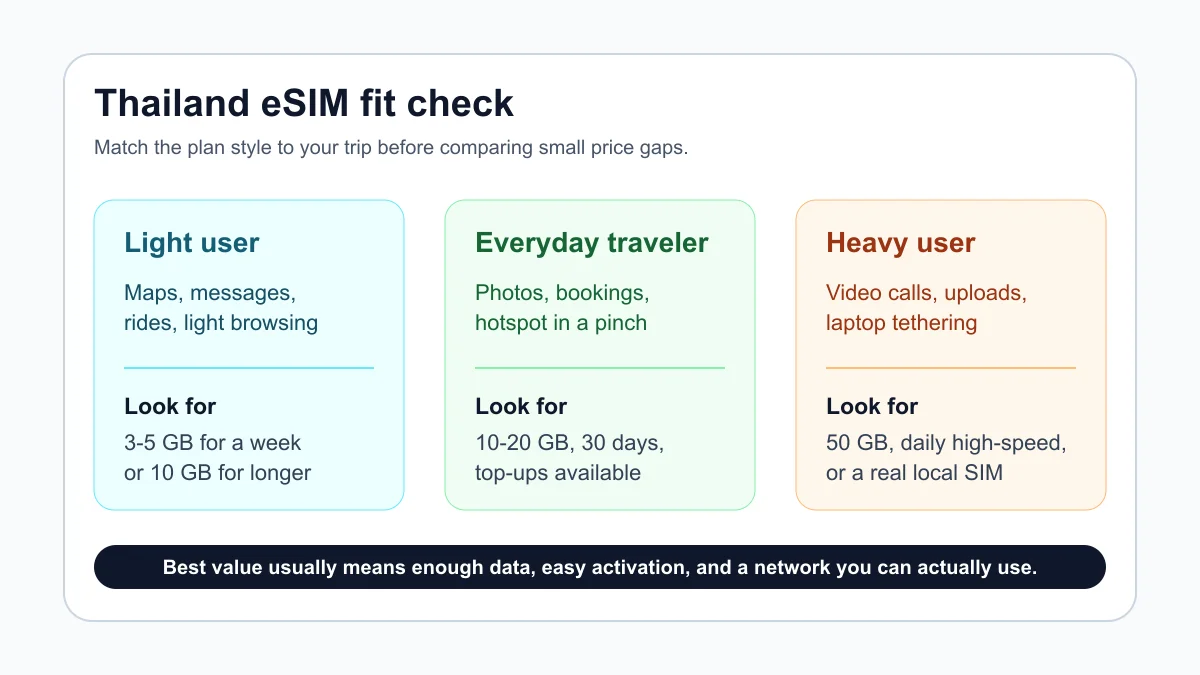
Choose around 3 GB to 5 GB if you mostly use maps, messaging, ride-hailing, hotel apps, and restaurant searches. Move toward 10 GB to 20 GB if you post video, use TikTok or Instagram heavily, upload cloud backups, or hotspot a laptop.
When Nomad, Airalo, or a local tourist SIM makes more sense
Nomad is the better shortlist option if you want bigger buckets, tethering, or a plan that names major Thai networks such as AIS and dtac. Its Thailand page has shown options from small 7-day data plans through larger 10-day and 30-day plans, plus hotspot support in its FAQ.
Airalo is worth checking if you already keep your travel eSIMs there or want a known app with local, regional, and global coverage options. For Thailand, its marketplace-style lineup can include fixed data packages and tourist-style plans, so read the activation rule carefully before you install.
Consider a local Thai tourist SIM or eSIM if you need a local phone number, lots of calls, or the lowest possible price for a long stay. The tradeoff is friction: airport counters, ID checks, queues, and plan details that may be easier to sort out in person than before departure.
How much Thailand data should you buy?
Start with 5 GB for a one-week city trip if you are disciplined about hotel Wi-Fi. For a two-week itinerary across Bangkok, Chiang Mai, Phuket, Krabi, or island transfers, 10 GB to 20 GB is the safer middle ground.
Remote work changes the math quickly. Video calls, cloud documents, hotspot use, and navigation running all day can burn through a small plan fast, especially if hotel Wi-Fi is unstable.
Do not buy unlimited just because the word feels comforting. Some unlimited-style plans still slow down after a daily high-speed allowance, while a fixed 20 GB or 50 GB plan may be easier to understand and track.
Setup timing: install early, activate deliberately
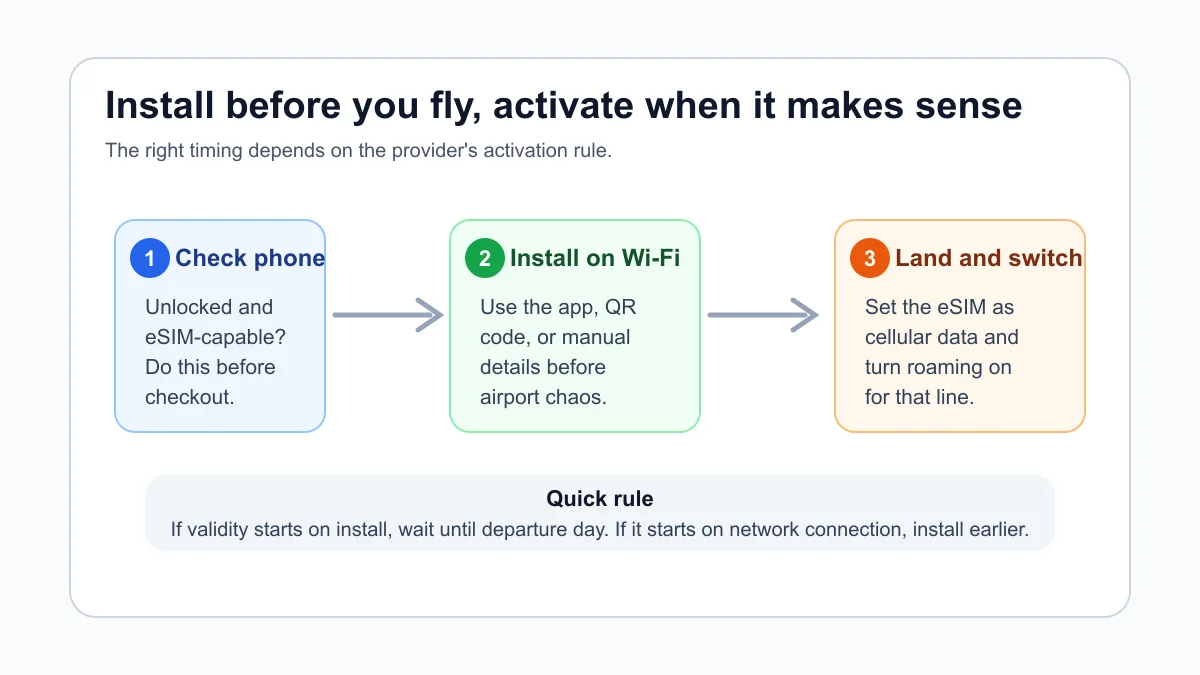
Install the eSIM while you still have reliable Wi-Fi, ideally at home or at your hotel before a travel day. What you should not do blindly is activate a plan days early if the validity clock starts at installation.
Apple’s current eSIM setup guidance says iPhone users can add plans by carrier activation, QR code, carrier app, link, or manual details, depending on the provider. Android menus vary, but the same practical rule applies: install on stable Wi-Fi and confirm which SIM line handles mobile data.
After landing, turn on the Thailand eSIM line, set it as cellular data, and enable data roaming for that line if the provider requires it. Keep your home SIM active only if you need SMS codes, and turn off data roaming on the home line to avoid surprise charges.
What to check before checkout
- Phone compatibility: Your phone must support eSIM and be carrier-unlocked.
- Validity trigger: Some plans start when installed; others start when they connect in Thailand.
- Network: AIS, dtac, and True are the local names you will usually see.
- Hotspot: Confirm tethering if you plan to work from a laptop or share data.
- Top-ups: A cheap plan is less useful if you cannot extend it easily mid-trip.
- Calls and texts: Most travel eSIMs are data-only unless the plan says otherwise.
How this fits with the rest of your trip planning
Provider comparisons help when you are choosing between familiar apps. If you are still weighing Airalo against another store, read our Nomad vs Airalo comparison and the broader Airalo vs Nomad vs Saily guide.
Longer trips need a different lens. Digital nomads should look at backup data and hotspot planning, while travelers comparing carrier add-ons can use our eSIM vs roaming cost math.
Setup problems are easier to fix before you delete anything. If activation fails on arrival, walk through these iPhone eSIM fixes first.
If Thailand is one stop in a larger itinerary, compare destination guides for Japan from Canada, Europe from Canada, Europe travel, Turkey, Mexico, and USA tourists. Deal hunters can also compare the logic in our cheap Europe eSIM guide, and unlimited-plan shoppers may want the Holafly vs Airalo breakdown.
Quick Checklist
- Choose Saily for a straightforward value pick on normal tourist trips.
- Check Nomad if you want larger data, hotspot clarity, or AIS/dtac network options.
- Compare Airalo if you already use its app or want regional backup choices.
- Confirm whether the plan starts at installation or first network connection.
- Install while you have strong Wi-Fi, then switch data lines after landing.
- Keep your home SIM data roaming off unless you intentionally need it.
- Save the provider help page or QR details offline before your flight.
Official Sources Checked
Provider details were checked against Saily Thailand eSIM plans and Nomad Thailand eSIM plans. Recheck before buying because prices, networks, and activation rules can change.
Bottom line: most travelers should start with Saily, then check Nomad if they need more data or clearer hotspot flexibility. Airalo remains a sensible comparison point, but the best choice is the one that fits your actual Thailand itinerary, not the one with the prettiest checkout page.
Frequently Asked Questions
what is the best eSIM for Thailand?
For most short Thailand trips, Saily is the easiest first pick because its plan ladder is simple and the entry price is low. Nomad is a strong alternative if you want bigger allowances, hotspot support, or named local network options.
is Airalo good for Thailand travel?
Airalo can be good for Thailand, especially if you already use the app and want a familiar checkout flow. Compare the exact plan against Saily and Nomad before buying, because the best value changes by data size and validity period.
how much data do I need for Thailand?
Light travelers can often manage with 3 GB to 5 GB for a week. For two weeks, mixed city and island travel, or frequent social uploads, 10 GB to 20 GB is a more comfortable range.
should I activate my Thailand eSIM before I arrive?
Install it before you fly if the provider allows early installation without starting validity. If the clock starts at installation, wait until departure day or arrival, then activate on reliable Wi-Fi.
do Thailand eSIMs include a phone number?
Many travel eSIMs are data-only, so calls and texts happen through apps such as WhatsApp, FaceTime, Messenger, or Signal. If you need a Thai number, look for a tourist SIM or an eSIM plan that explicitly includes calls.
can I use hotspot with a Thailand eSIM?
Often yes, but not always. Check the plan details before paying, especially if you need to tether a laptop for work or share data with another traveler.