Phone Setup
Data-Only eSIM or Phone Number: Which Should You Buy?
Compare esim data only vs phone number plans, when each makes sense, and how to keep calls, texts, maps, and roaming controlled.
If you searched for "esim data only vs phone number," the real question is not whether one is better. It is whether you need mobile data only, or whether a local number will solve a travel problem that apps cannot.
For most short trips, a data-only travel eSIM is enough. You can use maps, ride-hailing, email, iMessage, FaceTime, WhatsApp, Signal, and hotel apps while keeping your regular number on your phone for account codes and urgent calls.
| What you see | Likely cause | First move |
|---|---|---|
| The eSIM listing says data only | No local phone number is included | Plan to use app-based calls and messages |
| You need SMS for a local booking | The merchant may not accept VoIP or foreign numbers | Choose a plan with calls and texts, or buy a local prepaid line |
| Your home number still rings abroad | Your primary line is still active | Disable data roaming on the home line before using travel data |
| Activation asks for Wi-Fi | The eSIM profile needs an internet connection to install | Install before departure or use trusted airport Wi-Fi |
| Calls work in apps but not by dialer | The plan has data but no voice service | Use internet calling or switch to a voice-capable plan |
The Short Answer for Most Travelers
Pick data-only if your trip is short, your contacts already use messaging apps, and you mainly need maps, transit, email, translation, rides, and restaurant searches. That is the common travel pattern, and it usually costs less than a local line with voice and SMS.
Choose an eSIM with a phone number when local calls or SMS are part of the trip itself. Think apartment viewings, long stays, clinic appointments, local delivery apps, bank paperwork, car rental counters, or hosts who only answer a local call.
What Changes When an eSIM Includes a Number
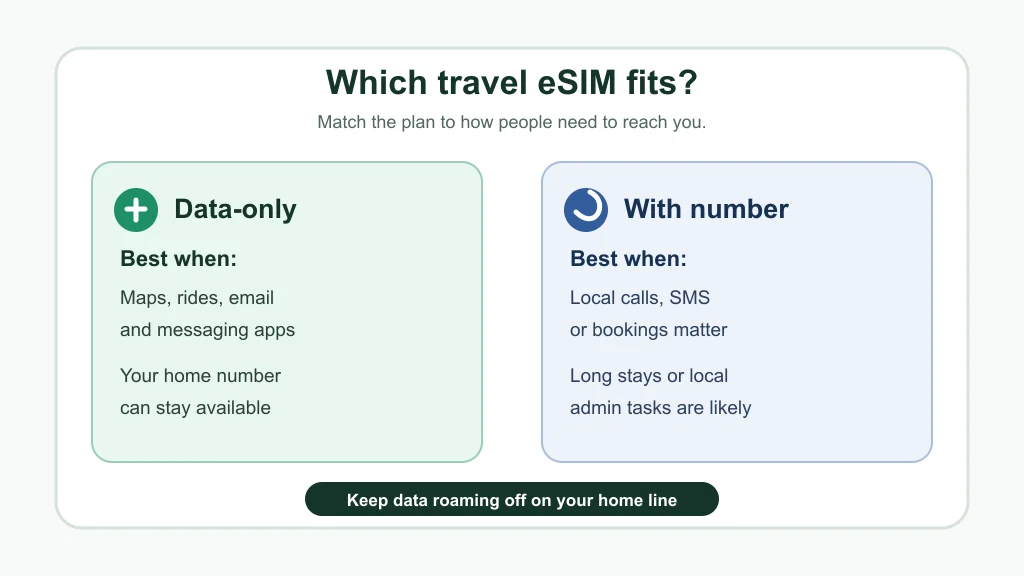
A data-only plan gives your phone internet access on a local or regional network. It does not add ordinary cellular calling or SMS through the dialer.
A phone-number eSIM adds a separate line. Depending on the provider, it may support inbound calls, outbound calls, texts, or a bundle of data, calls, and texts. Read the plan page carefully because the label "with number" does not always mean generous calling credit.
Providers also differ by country. One marketplace may sell data-only plans for most destinations but offer data, calls, and texts in select places. Airalo, for example, explains that its data/calls/texts eSIMs include a phone number while data-only eSIMs do not.
Where Data-Only Works Better
Data-only is usually the cleaner choice for vacations, city breaks, conference trips, and multi-country routes. You install one plan, set it as the cellular data line, and avoid swapping physical SIMs at the airport.
Messaging apps cover a lot of real travel communication. Hotels, guides, drivers, and friends often use WhatsApp, Messenger, iMessage, or email. Even airline and train updates usually arrive through apps or email.
Costs are easier to compare too. A fixed data bundle lets you estimate how much you need for maps, messaging, browsing, and hotspot use. If you are comparing carrier roaming against a travel plan, start with our eSIM vs roaming cost breakdown, then check whether a destination plan beats your carrier's daily pass.
Where a Local Number Is Worth Paying For
Need to call a local taxi dispatcher, receive local SMS, or complete paperwork that rejects foreign numbers? A phone-number eSIM can save time. The same is true for longer stays, student terms, work assignments, and trips where you expect more local admin than sightseeing.
Local numbers can also help in countries where restaurants, delivery platforms, medical offices, or landlords still prefer standard calls. You may not need it every day, but the one moment you need it can matter.
How to Keep Your Home Number Without Roaming Surprises
Dual-SIM phones make this easier than many travelers expect. Set the travel eSIM as the cellular data line, keep your home line available for calls or SMS only if you need it, and turn off data roaming on the home line.
Apple says supported iPhones can have two active eSIMs at the same time, and its travel guidance notes that a travel eSIM can be used as a secondary line. Apple also warns that keeping both lines on may still create roaming fees from the home line, so the settings matter.
Before you fly, install and test the plan on Wi-Fi. If you are using an iPhone, our set up a travel eSIM on iPhone guide walks through the timing, and does eSIM work without Wi-Fi explains what still needs an internet connection.
Decision Guide by Trip Type
Weekend city trip: choose data-only. You need navigation, booking apps, transit, and messaging more than you need a local dialer.
Two-week vacation with family: choose data-only unless your accommodation or activities require local SMS. Keep your home line reachable for urgent calls, but watch roaming settings.
Long stay or study abroad: lean toward a local number, especially if banks, landlords, delivery apps, or local services are involved. A local prepaid carrier eSIM may be a better fit than a travel marketplace plan.
Business travel: decide based on how people contact you. If everything runs through Teams, Slack, WhatsApp, email, and calendar invites, data-only is fine. If local clients call standard numbers, buy a plan that clearly supports voice.
Cruises are different. Port days and ship days follow separate rules, so read our cruise eSIM guide before assuming a normal destination eSIM will work offshore.
Destination Planning Notes
Country guides matter because plan features change by destination. For Europe, start with the Europe eSIM guide, the cheapest eSIM for Europe cost check, and the Europe from Canada eSIM guide if you are comparing against Canadian roaming passes.
For single-country trips, use the destination page first, then check whether the plan is data-only or includes calls and texts. We keep separate notes for the Spain eSIM guide, France eSIM guide, Italy eSIM guide, Iceland eSIM guide, and Turkey eSIM guide.
Outside Europe, your best choice can depend on identity checks, local app rules, and coverage. Use the Bali eSIM guide, Thailand eSIM guide, Mexico eSIM guide, and USA tourist eSIM guide for local details.
Provider Fit Matters Too
Marketplaces do not all solve the same problem. Some are strongest on fixed data bundles, some lean into unlimited-style plans, and some have better app setup or top-up flows.
If you are narrowing providers, compare Nomad vs Airalo for destination pricing and setup, or Holafly vs Airalo if you are choosing between unlimited-style data and fixed bundles. Remote workers should also read the digital nomad eSIM guide before depending on one plan for hotspot and backup data.
Having trouble after purchase? Do not delete the profile first. Work through eSIM not activating on iPhone checks before you risk losing the installation.
Quick Checklist
- Choose data-only for short trips built around maps, apps, email, and messaging.
- Choose a numbered eSIM if you must receive local calls or SMS.
- Confirm whether the plan includes calls, texts, both, or data only before checkout.
- Install the eSIM on Wi-Fi before departure when possible.
- Set the travel eSIM as your cellular data line after arrival.
- Turn off data roaming on your home line unless you intentionally want carrier roaming.
- Test app calling and messaging before you need them for a booking or ride.
Bottom Line
Buy the plan that matches the contact method you will actually use. Data-only is the right default for most travelers because it covers the daily stuff, while a phone-number eSIM is worth it when local calls, SMS, or longer-stay admin are part of the trip.
Frequently Asked Questions
Does a data only eSIM come with a phone number?
No. A data-only eSIM gives mobile data but does not include a standard phone number for cellular calls or SMS. You can still use internet-based calling and messaging apps.
Can I still use my phone number with a travel eSIM?
Yes, on dual-SIM phones you can usually keep your regular line available while the travel eSIM handles data. Turn off data roaming on the home line if you want to avoid surprise charges.
Do I need an eSIM with calls and texts for Europe?
Usually no for vacations. Most travelers can use data-only plans for maps, messaging, tickets, and rides. Consider calls and texts if you need local bookings, local SMS, or a longer stay.
Will WhatsApp work with a data only eSIM?
Yes. WhatsApp, FaceTime, iMessage, Signal, Messenger, and similar apps work over mobile data as long as the app is already set up and the data connection is active.
Is a local phone number better than roaming?
Sometimes. A local number can be better for long stays or local services, while roaming can be simpler if your carrier includes affordable international coverage. Compare the total trip cost before deciding.
Official sources: Do eSIMs Come With a Phone Number? · Use eSIM while traveling internationally with your iPhone. Check current program pages before applying.