Destination eSIMs
The Best eSIM for UK Travel Depends on Your Route
Find the best esim for UK travel by route, data needs, coverage checks, phone setup, hotspot rules, and common buying traps.
Choosing the best esim for uk travel is less about finding one universal winner and more about matching the plan to your route, phone, and tolerance for setup hassle. A London weekend, a train loop through Scotland, and a work-heavy month in Manchester all push you toward different choices.
Here is the practical way to shop: start with device compatibility, then decide whether you need cheap fixed data, a local-style UK option, or an unlimited-style plan with clear hotspot rules. Prices and promotions change often, so treat checkout pages as the final source for current allowance, validity, network, and fair-use terms.
| What you see | Likely cause | First move |
|---|---|---|
| A cheap plan with very little data | Good for maps and messages, weak for video or tethering | Estimate daily use before buying |
| An unlimited-style offer | May have speed, hotspot, or fair-use limits | Read the plan details, not just the headline |
| A provider mentions EE, O2, Three, or Vodafone | The eSIM rides on a UK mobile network | Check coverage for your actual postcode route |
| The QR code must be installed before travel | The plan needs Wi-Fi or app access to activate cleanly | Install before the airport, activate per provider instructions |
| You need calls or SMS in the UK | Many travel eSIMs are data-only | Consider a provider that includes a number or keep your home line active |
Best eSIM for UK travel: quick picks by traveler
Pick a fixed-data travel eSIM if you want the simplest answer for a short UK visit. Saily, Airalo, Nomad, and similar marketplace providers usually make sense for travelers who mainly need maps, messaging, tickets, ride apps, and casual browsing.
Choose a UK carrier-backed or local-style option if you care most about domestic network behavior. The competitor brief surfaced Sim Local on EE, Lyca, and giffgaff as common UK-focused options, which is why they are worth checking when calls, SMS, or a familiar UK network matter more than app polish.
Look at Holafly-style unlimited plans only when you know you will use a lot of data. I am a little skeptical of “unlimited” as a shopping shortcut, because hotspot limits and fair-use language matter more than the label when you are working from a laptop.
First, make sure your phone can use a travel eSIM
Start with the boring check because it prevents the most expensive mistake. Your phone needs eSIM support, it needs to be unlocked for another provider, and you need enough internet access during installation to download the profile.
Apple says compatible iPhones can use eSIM while traveling internationally, and that iPhone needs Wi-Fi or a hotspot for setup in many cases. If you are moving phones before the trip, handle that first with our guide to moving a travel eSIM to a new iPhone.
Not every plan includes calls or texts. If that distinction is new, read Data-Only eSIM or Phone Number: Which Should You Buy? before you pay for a plan that cannot receive normal SMS.
Compare UK plans on the details that actually change the trip
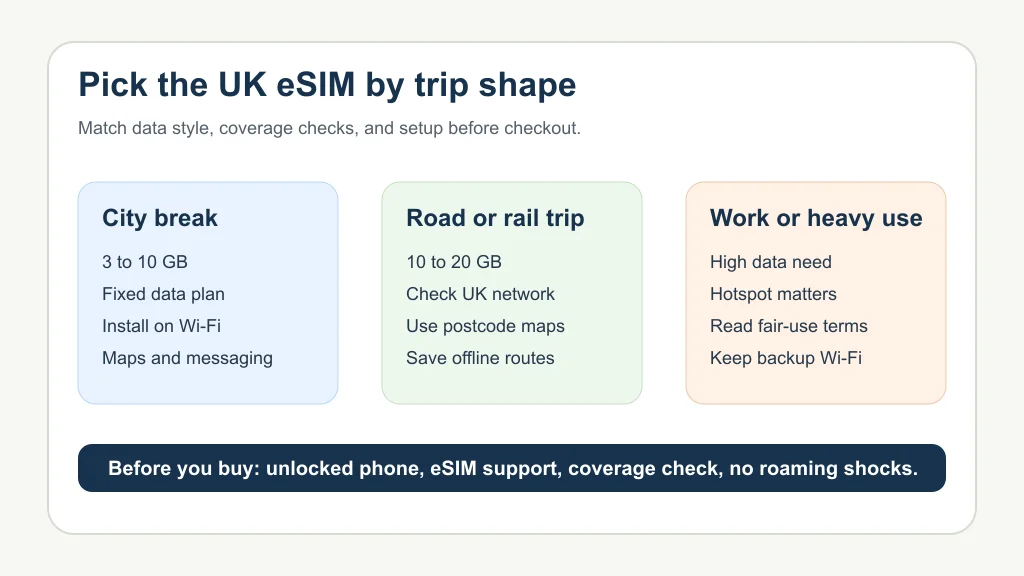
Begin with data allowance and validity. A 3 GB plan can be enough for a careful long weekend in London, while 10 GB to 20 GB is more realistic if you use maps all day, upload photos, stream on trains, or tether a tablet.
Check the network note next. UK coverage can vary by building, rail line, coast, and rural road, so a provider that looks perfect in central London may not be the best match for the Highlands, Cornwall, or a countryside stay.
Use Ofcom's mobile checker for the places where signal matters most. Put in hotel, university, office, rental cottage, or family postcode details when you have them, then compare predicted network coverage before buying a plan tied to one UK network.
How much data should you buy for the UK?
Buy less if your hotel Wi-Fi is reliable and your phone use is mostly maps, chat, transport apps, restaurant searches, and boarding passes. For that pattern, a fixed-data plan keeps costs predictable.
Buy more if you are uploading video, hotspotting a laptop, taking long train rides, or using cloud backups. Unlimited-style data can be useful here, but only after you confirm hotspot support and any speed-management terms.
For the same comparison habit in nearby destinations, see our guides to France travel eSIMs, Spain travel eSIMs, and Italy travel eSIMs. Europe trips can look similar on a sales page, but trains, islands, and rural routes change the better buy.
When a UK local-style SIM beats a travel marketplace eSIM
Consider a UK-focused option if you need a phone number, expect support from a local brand, or will stay long enough that top-ups matter. Some travelers prefer that route because it feels closer to buying a domestic plan than a temporary travel data pass.
Stick with a marketplace travel eSIM if you want quick app purchase, easy pre-trip installation, and no need for local calling. That is the simpler path for most visitors who only need data for a week or two.
Planning a multi-country trip after the UK? Compare the total route, not just the London leg. Our guides to Morocco eSIMs, Iceland eSIMs, Bali eSIMs, Turkey eSIM setup, Mexico roaming alternatives, and Thailand travel eSIM picks can help you avoid buying one plan for the wrong kind of route.
Setup steps before you fly
- Confirm your phone is unlocked and eSIM-compatible. Do this before comparing plans.
- Buy from a provider with clear UK coverage notes. If it names a network, check that network against your route.
- Install the eSIM on reliable Wi-Fi. Airports are a bad place to troubleshoot a QR code.
- Label the line clearly. Use a name like UK Data so you do not confuse it with your home number.
- Keep your home line controlled. Leave it available for texts if needed, but avoid accidental roaming data.
- Test the provider app before departure. Make sure you can open support, see the plan, and find activation instructions.
For iPhone setup help, use how to set up a travel eSIM on iPhone before you fly. If you may be without Wi-Fi on arrival, read Does eSIM Work Without Wi-Fi? before relying on a plan you have not installed yet.
Common buying mistakes to avoid
Do not buy purely by price. A bargain plan can become annoying if support is slow, top-ups are awkward, or the allowance runs out halfway through a rail trip.
Do not assume every Europe plan covers the UK the same way. Some regional plans include the UK, some country plans are UK-only, and some network notes make a big difference once you leave the city center.
Do not delete a profile during troubleshooting unless the provider tells you to. If your line fails to activate, use these iPhone eSIM activation fixes first.
Provider comparison shortcuts
Use fixed-data marketplaces when you want clear allowances and lower commitment. Use unlimited-style providers when you know you will be data-heavy and the fair-use terms still work for your trip.
Provider comparisons are useful when the names blur together. Start with Nomad vs Airalo if you are choosing between fixed-data marketplaces, and read Holafly vs Airalo if the decision is unlimited-style data versus flexible fixed plans.
Budget-focused travelers should compare the whole trip cost, not only the first plan price. Our cheap Europe eSIM cost guide and eSIM vs roaming cost math make that tradeoff clearer.
Special cases: cruises, work trips, and longer stays
Cruises are different because a UK eSIM only helps in port or near land-based coverage. Read Best eSIM for Cruise Travel before assuming ship days are covered.
Remote workers should prioritize hotspot rules, video-call reliability, backup data, and support speed. Our guide to the best eSIM for digital nomads is a better starting point if your UK trip is really a work base.
Quick Checklist
- Confirm your phone supports eSIM and is unlocked.
- Decide whether you need data only or a UK phone number.
- Check Ofcom coverage for the postcodes or regions that matter.
- Compare fixed data, unlimited-style data, hotspot rules, and validity.
- Install on Wi-Fi before travel, then label the line clearly.
- Keep offline maps and provider support details saved.
- Recheck checkout terms before paying because plans and prices change.
Official sources: Apple Support: Use eSIM while traveling internationally with your iPhone · Ofcom: Map Your Mobile coverage checker.
The best UK eSIM is the one that fits your real route. For most visitors, that means a clean fixed-data plan, installed before departure, with enough allowance for maps and messaging. For heavy users, longer stays, or rural travel, spend more time on coverage, hotspot terms, and support before you buy.
Frequently Asked Questions
what is the best eSIM to use in the UK?
For most short trips, the best UK travel eSIM is a fixed-data plan with enough allowance for maps, messaging, tickets, and browsing. Heavy users should compare unlimited-style options, hotspot rules, and fair-use language before buying.
do uk travel esims include a phone number?
Many travel eSIMs are data-only and do not include a regular UK phone number. If you need calls or SMS, check local-style UK options or keep your home number active for verification texts.
how much data do i need for a week in the uk?
Light users can often manage with 3 GB to 5 GB. A safer range for maps, social apps, photo uploads, and train travel is 10 GB or more, especially if you will not trust public Wi-Fi.
should i buy a uk only esim or a europe esim?
Buy a UK-only eSIM if the trip is only England, Scotland, Wales, or Northern Ireland. Buy a Europe plan if you will continue to France, Spain, Italy, Ireland, or another nearby stop and the plan clearly includes the UK.
can i install a uk esim before landing?
Usually, yes. Install the eSIM on Wi-Fi before your flight, then follow the provider's activation timing. Some plans activate at installation, while others start when they connect to a supported network.