Destination eSIMs
Cheapest Japan Travel eSIMs in 2026: What to Buy Before You Fly
Compare the cheapest esim for japan travel, current Japan plan value, data needs, setup checks, and when roaming still makes sense.
If you are searching for the cheapest esim for japan travel, the real answer is not always the plan with the smallest price tag. Japan eSIM deals change fast, so the better move is to compare total data, validity, hotspot rules, and the network behind the plan before you buy.
For most travelers, the best value in June 2026 is a fixed-data Japan plan around 10 GB to 20 GB for a one- or two-week trip. Tiny plans are fine for maps and messages, but they get expensive fast if you use Instagram, video calls, TikTok, cloud photo backup, or laptop tethering.
| What you see | Likely cause | First move |
|---|---|---|
| A 1 GB plan looks cheapest | The headline price hides a high cost per GB | Compare 5 GB, 10 GB, and 20 GB tiers before checkout |
| Unlimited data looks like a bargain | Fair-use throttling may slow heavy days | Read the speed policy and hotspot terms |
| Two plans have similar prices | Different networks, validity, or top-up rules | Choose the one with clearer coverage and easier support |
| The eSIM will not install | The phone is locked, unsupported, or offline | Confirm compatibility and install on Wi-Fi before flying |
Who has the cheapest esim for japan travel right now?
MobiMatter is the first place I would check for pure price-per-GB. At the time of this run, its Japan page showed marketplace plans from about $0.3 per GB, and one visible 20 GB, 30-day Japan offer at $13.99. That is the kind of deal that can beat many familiar travel eSIM brands on raw value.
Price is only one part of the decision. Marketplace offers can come from different underlying providers, so you need to check the network, top-up process, expiry window, and whether the plan is data-only. If the checkout page is vague, skip it. Saving a few dollars is not worth landing at Haneda with a plan you cannot troubleshoot.
The value sweet spot for a Japan trip
A 3 GB to 5 GB plan can work for a short Tokyo or Osaka visit if you mostly use hotel Wi-Fi and keep video off cellular. It is usually enough for transit apps, maps, messaging, translation, restaurant searches, and occasional photo uploads.
A 10 GB to 20 GB plan is the safer buy for most visitors. Japan travel tends to be data-heavy because you are constantly using maps, train routing, translation, ticket apps, and image sharing. I would rather have a little unused data than start rationing maps on day nine.
Heavy users should look at 30 GB, 50 GB, or unlimited-style plans, but read the fine print. Some unlimited offers slow after a daily threshold, and some fixed-data plans block or limit hotspot use. That matters if you plan to tether a laptop from a hotel, shinkansen seat, or coworking space.
Provider types worth comparing
Think of Japan eSIM sellers in three buckets. Marketplaces such as MobiMatter can be the cheapest because they list offers from several suppliers. Direct travel eSIM brands such as Ubigi, Airalo, Nomad, Saily, and Holafly can cost more, but the app experience and support flow may be easier.
Unlimited-data brands are worth considering only if you know you will stream, work from hotspot, or travel with someone who keeps borrowing your connection. Otherwise, fixed data usually wins on price. Honestly, most travelers overestimate how much data they need until one automatic photo backup ruins the budget.
Coverage claims also deserve a sober look. Many Japan travel eSIMs roam on major local networks, but the seller page may not always make the exact network obvious. If you are staying mostly in Tokyo, Osaka, Kyoto, Fukuoka, or Sapporo, most reputable plans should be fine. If you are heading into mountain towns, islands, ski areas, or long rural routes, favor the provider that states network details clearly.
Japan eSIM value comparison
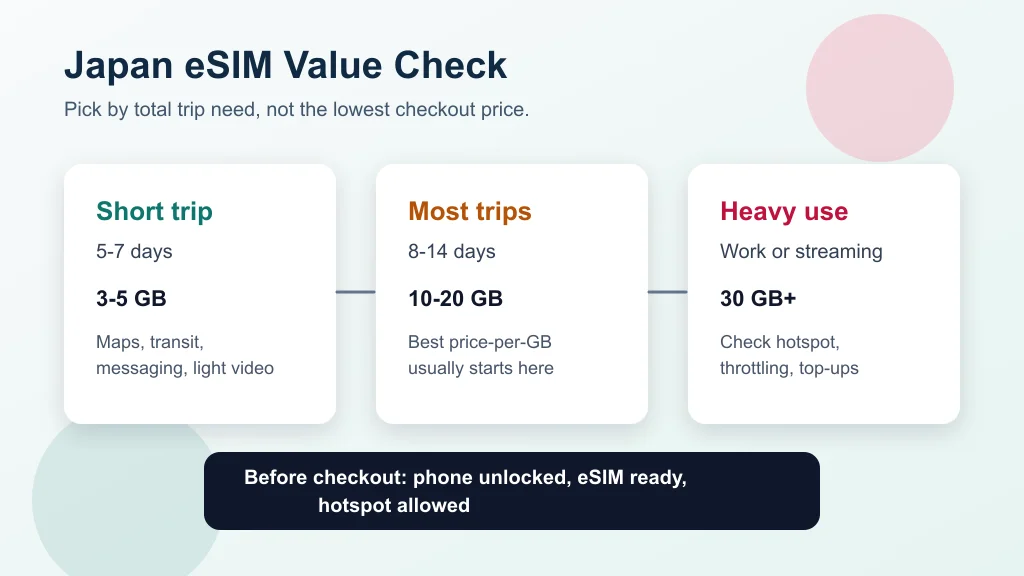
Use this quick comparison before you open your wallet. It keeps the decision grounded in how you will actually travel, not how good the checkout page looks.
- Lowest price-per-GB: Start with marketplaces, then verify the supplier, validity, and top-up path.
- Simplest app experience: Direct brands may be easier for first-time eSIM users.
- Short city break: 3 GB to 5 GB is usually enough if you avoid video on cellular.
- Two-week itinerary: 10 GB to 20 GB is the practical middle ground.
- Work or hotspot use: Check hotspot permission before comparing price.
- Unlimited plans: Read speed limits and fair-use language before assuming it means full-speed data all day.
Setup checks before you pay
Start with your phone, not the eSIM store. Apple says iPhone travelers generally need an iPhone XS, XR, or later, a provider that supports eSIM, and a Wi-Fi or hotspot connection for setup in most cases. Android support varies by model and region, so do not guess.
Make sure your phone is carrier-unlocked. A locked phone can block a travel eSIM even when the model supports eSIM. You should also install the eSIM before departure while you still have stable Wi-Fi, but wait to turn on the Japan data line until the provider instructions say to activate it.
Keep your home SIM active if you need bank codes, airline alerts, or two-factor messages. Many cheap Japan eSIMs are data-only, so they do not replace your normal phone number. If that is a problem, read our data-only eSIM or phone number guide before buying.
How much data should you buy?
Maps and messaging are light. Short videos, hotspot, video calls, cloud backups, and app updates are not. If you want a simple rule, budget 500 MB to 1 GB per day for normal travel, then add more if you plan to work, stream, or share data with another device.
For a seven-day trip, 5 GB is comfortable for a disciplined user and 10 GB is relaxed. For 10 to 14 days, 10 GB can work, while 20 GB gives you breathing room. For a month, 30 GB or more starts to make sense, especially if you are moving around Japan without dependable hotel Wi-Fi.
Business travelers should be stricter about hotspot rules, support hours, and backup plans. Our best eSIM for business travel guide goes deeper on that because losing data before a call is more than an inconvenience.
When roaming still makes sense
Cheap eSIMs usually beat international roaming, but not always for every person. If your home plan includes Japan at no extra cost, or if you need your phone number for voice calls all day, roaming can be simpler. Compare the total trip cost against an eSIM, not just the daily fee.
Our eSIM versus international roaming cost guide explains that tradeoff in more detail. The short version is simple: eSIMs win for data value, while roaming wins when convenience and number continuity matter more than price.
Provider comparisons to read next
If you are narrowing the field, compare provider behavior before you compare checkout buttons. For Japan specifically, Airalo vs Ubigi is a natural follow-up because both are common choices for first-time travelers.
Other provider matchups help if your Japan trip is part of a bigger route. Read Saily or Airalo comparison if privacy tools matter, Holafly vs Nomad if you are debating unlimited-style data, and our Airalo vs aloSIM comparison if app support is high on your list.
Related destination planning
Building a multi-country trip? Pair this Japan check with the Southeast Asia eSIM picks if you are continuing through Thailand, Vietnam, Singapore, or Indonesia. For other long-haul trips, we also keep practical destination guides for Australia, Canada, the UK, Morocco, Greece, Portugal, Spain, France, and Italy.
Setup issues can ruin even a cheap plan. Bookmark the iPhone hotspot troubleshooting guide if you plan to tether, the steps to move a travel eSIM to a new iPhone if you are changing devices before departure, and the guide to a travel eSIM with a phone number if data-only service feels too limiting.
Quick Checklist
- Check MobiMatter or another marketplace for current Japan price-per-GB.
- Compare at least one direct provider for app support and top-up convenience.
- Buy 3 GB to 5 GB for a short light-use trip, 10 GB to 20 GB for most trips, and 30 GB+ for work or streaming.
- Confirm your phone is unlocked and eSIM-compatible before checkout.
- Read hotspot, throttling, expiry, and activation timing rules.
- Install the eSIM on Wi-Fi before your flight, then activate data according to the provider instructions.
- Keep your home SIM available if you need text codes or your normal phone number.
Official sources checked: MobiMatter Japan eSIM plans · Apple travel eSIM support.
The cheapest Japan eSIM is usually a fixed-data plan with a low cost per GB, enough validity for your whole route, and clear setup rules. Start with marketplace pricing, sanity-check it against a direct provider, and buy the plan that leaves you enough data to travel normally. That is the real bargain.
Frequently Asked Questions
what is the cheapest esim for japan?
For raw price-per-GB, marketplace plans often come out cheapest. At the time checked, MobiMatter showed Japan offers from about $0.3 per GB, but prices change often, so verify the exact plan before paying.
how many gb do i need for japan travel?
Light users can manage with 3 GB to 5 GB for a week. Most travelers are better with 10 GB to 20 GB, especially if they use maps, transit apps, translation, social media, and photo sharing every day.
is unlimited esim worth it in japan?
Unlimited can be worth it for heavy hotspot, video, or work use. For normal sightseeing, a fixed 10 GB or 20 GB plan is often cheaper and easier to compare.
can i install a japan esim before i fly?
Yes, and you usually should. Install it while you have stable Wi-Fi at home, then follow the provider instructions on when to activate the Japan data line.
do japan travel esims include a phone number?
Most cheap Japan travel eSIMs are data-only. Use WhatsApp, FaceTime, Signal, Google Voice, or your home SIM for calls and texts unless the plan clearly includes a number.