Roaming Guides
eSIM or International Roaming: What Travelers Actually Pay
Compare esim vs international roaming cost by trip length, data needs, calls, texts, and hidden roaming charges before you buy.
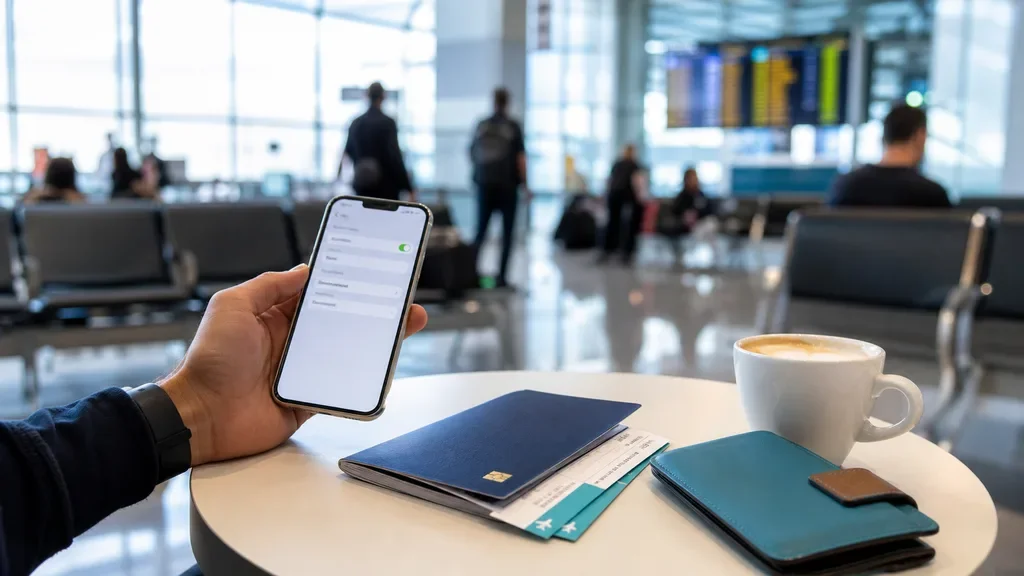
If you are comparing esim vs international roaming cost, start with the trip length, not the brand name. Roaming is easy because your regular number keeps working, while a travel eSIM usually gives you prepaid data with a clearer spending ceiling.
For most travelers, the cheaper choice depends on three things: how many days you will use mobile data, whether you need calls and SMS from your home number, and how much setup friction you are willing to accept before landing.
| What you see | Likely cause | First move |
|---|---|---|
| Your carrier quotes a daily travel pass | Roaming is priced by each day you use it | Multiply the day rate by active travel days before comparing eSIMs |
| The eSIM plan looks cheap but data is limited | You are buying a fixed prepaid bucket | Estimate maps, rideshare, uploads, hotspot, and video calls |
| You need banking texts or voice calls | Many travel eSIMs are data-only | Keep your home SIM active, then set the eSIM for mobile data |
| Your trip crosses several countries | Country plans may not cover the full route | Compare regional eSIMs against daily roaming for the whole itinerary |
eSIM vs international roaming cost: the quick math
Run the roaming number first because it is the easiest one to miss. If a daily pass costs $12 and you trigger it on seven days, you are already around $84 before taxes and any plan-specific limits.
A travel eSIM works differently. You usually pay upfront for a destination, region, data amount, and validity window, so the bill cannot keep growing in the same way unless you buy top-ups.
Roaming can still be worth it for a two-day work trip where you need your normal phone number, calls, and texts with no setup. Once the trip gets longer, the daily fee often becomes the number to beat.
Why roaming feels easier but can cost more
Roaming uses your home carrier and partner networks abroad. You land, turn on cellular data, and your phone behaves almost like it does at home.
Convenience is the whole pitch. Verizon, for example, currently lists TravelPass at $12 per line per day in many countries, with Canada and Mexico priced lower on that page and high-speed data limits before slower speeds apply.
That is clean for short trips. It is less clean when you are away for ten days, tether a laptop, or forget that every active roaming day can start another charge.
Roaming also keeps your number reachable. If you expect bank verification texts, client calls, airline callbacks, or family calls to your regular number, that may be worth paying for.
Why travel eSIMs usually win on budget control
A travel eSIM is usually a data plan you install digitally. Airalo's own explainer frames eSIMs as a middle option: more convenient than hunting for a local SIM, usually more controlled than roaming, and often useful for multi-country trips.
Budget control is the main advantage. You can buy 5 GB, 10 GB, regional coverage, or a short unlimited-style plan before the trip, then use it as the data line while your home SIM stays available for calls or texts.
There is a catch. Many travel eSIMs are data-only, so ordinary phone calls and SMS may still depend on your home carrier, Wi-Fi calling, iMessage, WhatsApp, FaceTime, or another messaging app.
When a local SIM is still the cheapest option
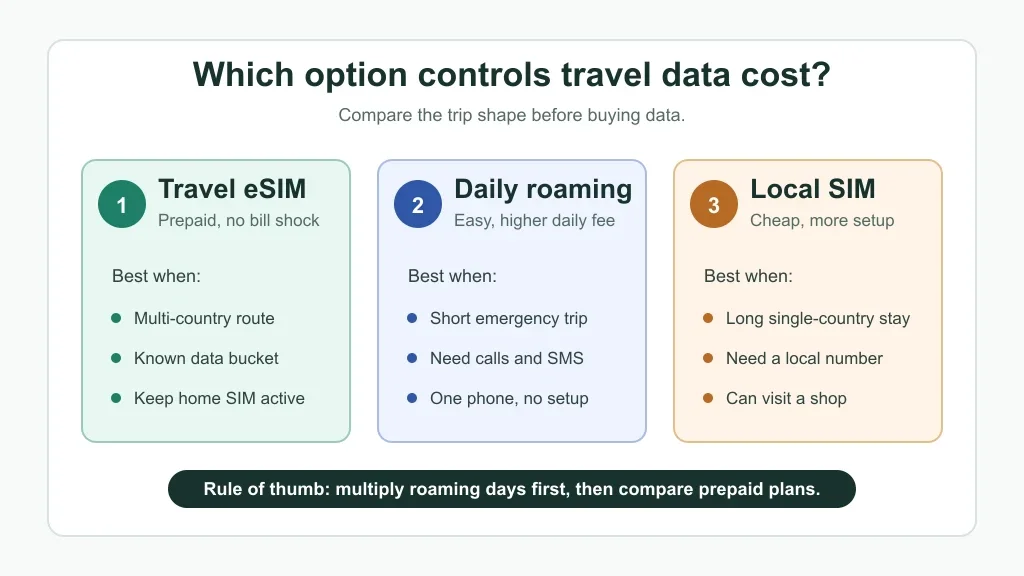
Local SIM cards can be the bargain pick for a long stay in one country. You are closer to resident pricing, and some destinations offer large data bundles for less than a travel eSIM marketplace can match.
Tradeoffs show up fast. You may need to find a shop, show ID, deal with activation instructions in another language, swap physical SIMs, or lose easy access to your home number unless your phone supports dual SIM.
For a month in one country, the effort can be worth it. For a five-day route through three countries, the time cost often wipes out the savings.
How to compare the real cost before you buy
Use a simple worksheet. First, count the number of days you will need mobile data away from hotel Wi-Fi. Include airport days, train days, and the morning you leave.
Second, estimate data. Maps, messaging, email, ride apps, and restaurant searches are light. Video, cloud photo backup, hotspot, TikTok, and remote work are not.
Third, decide whether phone-number continuity matters. If you need normal calls or SMS, roaming may be a convenience fee rather than a pure data product.
Finally, compare the full trip cost. A prepaid eSIM that looks more expensive than one day of roaming may still beat five or ten roaming days.
Trip examples that change the answer
Weekend city break: roaming can be reasonable if your carrier day pass works in the destination and you do not want to install anything. The convenience premium is small when the trip is tiny.
Seven-day vacation: a travel eSIM often becomes the better value, especially when you mostly need maps, messaging, transit apps, and light browsing. Keep roaming off unless you need your home number.
Two-week Europe route: look at regional eSIMs before daily roaming. A plan that covers every country on your route is usually easier than juggling country plans or paying a daily pass repeatedly.
One-month single-country stay: check local SIM pricing too. A travel eSIM may be easier on arrival, but local prepaid plans can win once you are settled.
Hidden costs people forget
Activation timing matters. Some eSIMs start validity as soon as they connect to a supported network, while others may start earlier, so read the plan wording before installing in a rush.
Hotspot use matters even more. A plan that is fine for phone maps can disappear quickly if you tether a laptop, upload video, or let cloud backup run over cellular.
Coverage also has a cost. A cheaper plan is not cheaper if it does not cover the island, cruise port, rural route, or border crossing where you need data most.
Related checks for common travel routes
Destination guides help when the country matters more than the product label. Start with Australia, Canada, Greece, Portugal, Southeast Asia, the UK, Morocco, Spain, France, Italy, and Bali.
Provider comparisons are useful once you know your route. Compare Holafly vs Nomad, Saily vs Airalo, and Airalo vs Ubigi before choosing a marketplace.
Setup details can prevent expensive mistakes. Check whether a travel eSIM with a phone number is worth it, whether a data-only eSIM is enough, how to move an eSIM to a new iPhone, how to fix an iPhone hotspot that fails, and whether an eSIM works without Wi-Fi. Cruise trips need their own math, so read the cruise travel eSIM guide before relying on port-day data.
Quick Checklist
- Multiply your carrier's daily roaming rate by every day you might use data.
- Match eSIM validity days to your arrival, stopovers, and departure.
- Estimate data for maps, messaging, rideshare, hotspot, uploads, and video calls.
- Confirm whether the eSIM is data-only or includes calls and SMS.
- Check supported countries, hotspot rules, throttling, and activation timing.
- Keep your home SIM available if you need banking texts or regular calls.
- Turn data roaming off after testing your travel eSIM.
Bottom line
Pick roaming when the trip is short, your carrier's daily pass is clear, and keeping your regular number fully active matters more than the cheapest data. Pick a travel eSIM when you want prepaid control, a longer trip window, or regional coverage without daily charges stacking up.
Local SIMs still deserve a look for long single-country stays. For most ordinary vacations, though, the best answer is simple: price the full roaming total first, then see whether a prepaid eSIM can cover the same route with less risk.
Official sources: Airalo eSIM vs SIM vs roaming explainer · Verizon TravelPass pricing page.
Frequently Asked Questions
is eSIM cheaper than international roaming?
Usually, yes, once the trip lasts more than a couple of days. Roaming can be simpler for short trips, but a prepaid eSIM often gives you better control over total data cost.
should I turn off roaming if I use an eSIM?
Yes, turn off data roaming on your home line unless you intentionally want to use your carrier's roaming plan. Set the travel eSIM as the mobile data line and test it after landing.
can I receive texts while using a travel eSIM?
Often, yes, if your home SIM stays active for calls and SMS. The travel eSIM can handle mobile data while your regular line remains available for verification texts, depending on your carrier and phone settings.
is roaming better than eSIM for short trips?
Roaming can be better for a one- or two-day trip if you need immediate service, normal calls, and no setup. For longer trips, daily charges can climb quickly.
how much data do I need for travel maps and messaging?
Light travelers can often manage with a few gigabytes for maps, messaging, email, and ride apps. Add more if you use hotspot, upload photos, stream video, or work from your laptop.