Provider Reviews
Airalo vs Ubigi: Which Travel eSIM Should You Pick?
Compare airalo vs ubigi by coverage, setup, top-ups, device support, and traveler type before buying your next travel eSIM.
If you are comparing airalo vs ubigi, do not choose from a logo or a single Reddit comment. Pick based on where you are going, how much data you need, whether you expect to tether, and how comfortable you are installing or topping up an eSIM mid-trip.
Short answer: Airalo is usually the easier marketplace pick when you want lots of country choices in one familiar app. Ubigi becomes more interesting for repeat travelers who like its single-profile approach, laptop support, and app-based top-ups.
| What you see | Likely cause | First move |
|---|---|---|
| One provider is cheaper for 1GB | Starter plans can hide the real trip cost | Compare the data amount you will actually use |
| Ubigi mentions one reusable profile | Its model favors installing the profile once and recharging it | Check whether your destination plan supports the countries you need |
| Airalo has more familiar country pages | Airalo works like a broad eSIM store with local, regional, and global options | Open the exact destination plan before deciding |
| Your iPhone says no service after install | The data line, roaming toggle, or APN may not be set correctly | Use Wi-Fi and fix settings before deleting the eSIM |
Airalo vs Ubigi: Quick Verdict for Travelers
Airalo is the safer first stop if you want a straightforward buying flow, a big destination catalog, and quick comparison between local and regional travel plans. For a practical airalo vs ubigi decision, that familiar app experience matters when you are trying to buy data at an airport gate with five minutes of patience left.
Ubigi is stronger when you like the idea of keeping one eSIM profile installed and topping it up for future destinations. Ubigi also emphasizes compatibility beyond phones, including tablets and some laptops, so it deserves a closer look if your travel setup includes more than one device.
Where Airalo Usually Makes More Sense
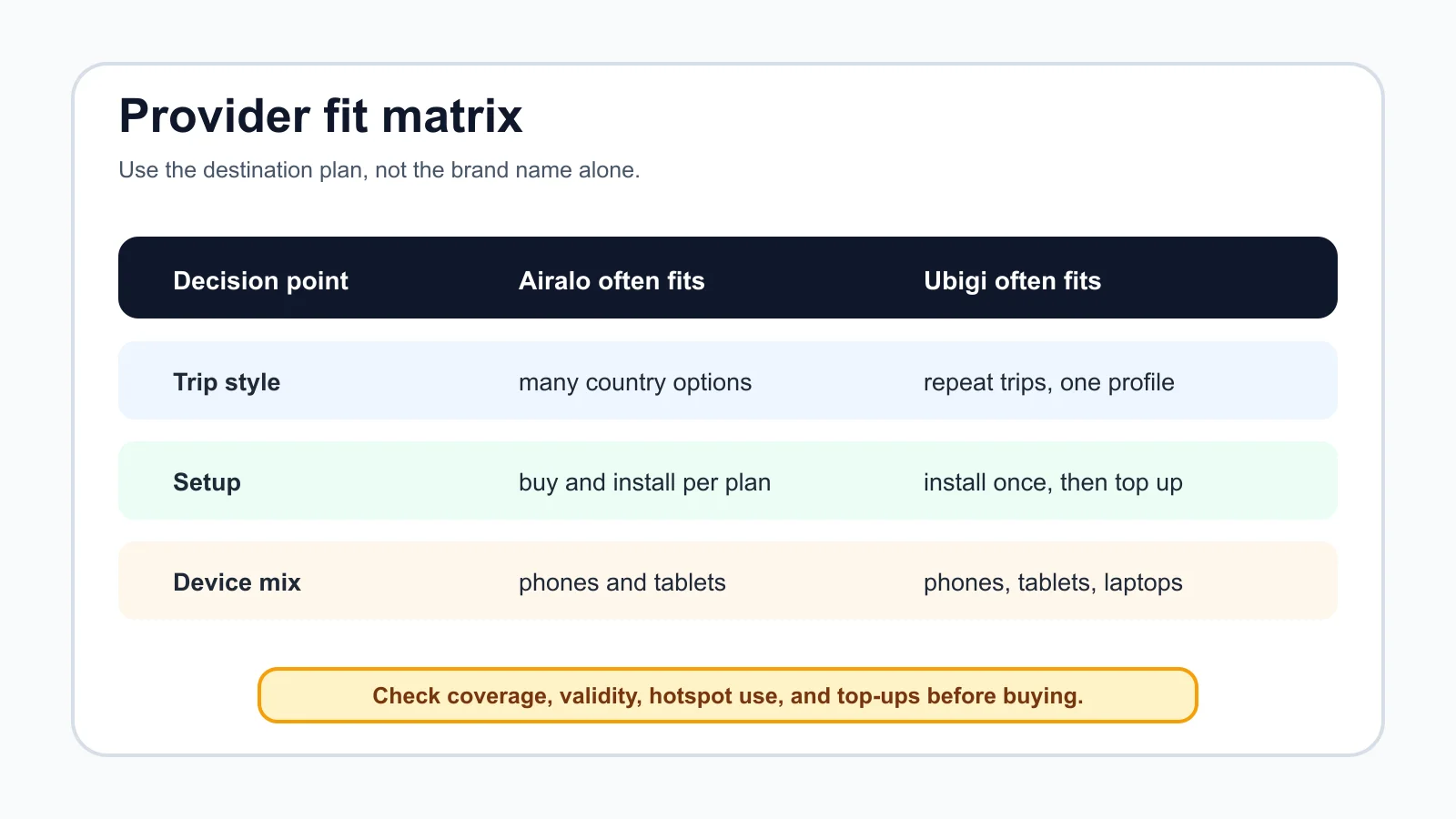
Choose Airalo first when you want a familiar eSIM marketplace with many destination pages and a buying flow that feels similar across countries. That matters for short trips, family trips, and first-time eSIM users who do not want to learn a new setup every time.
Airalo also works well when you are comparing several places at once. If your trip jumps from France to Spain to Italy, you can compare country-specific offers against regional Europe plans, then decide whether one regional package beats several smaller local plans.
One weak spot is that some Airalo eSIMs are not reusable forever. Airalo says the same eSIM can be used again only when it has eligible top-up options and remains installed on your device, so treat top-up availability as a plan detail, not a brand promise.
Where Ubigi Can Be the Better Fit
Ubigi is worth checking when you travel often and hate reinstalling new profiles. Its own help pages describe an eSIM profile that can stay on the device, which makes the airalo vs ubigi choice partly about whether you prefer a fresh marketplace plan or a profile you can keep topping up.
That model is especially appealing for repeat Japan, Europe, or business travel, where you may prefer a familiar profile that is already sitting in your phone settings. Less setup can mean fewer mistakes, as long as the plan price and destination coverage still make sense.
Ubigi also leans into connected-device support. If you carry an iPad, Windows laptop, or eSIM-capable business device, compare Ubigi carefully before assuming a phone-focused marketplace is the better choice.
Price, Coverage, and Speed Are Destination Questions
Do not treat one speed test or one Japan thread as proof for every trip. eSIM performance depends on the local network partner, congestion, plan routing, phone band support, and whether you are in a city, train station, island, or rural road.
For airalo vs ubigi, compare the destination page you are actually buying. Look at the country or region, data allowance, validity window, 4G or 5G language, top-up rules, and whether tethering is allowed.
Price per GB helps, but it can mislead. A cheap 1GB plan is not cheap if you need 10GB, and a generous regional plan is not useful if one country on your route is missing.
Setup and Top-Ups: The Detail People Skip
Setup is where most travel eSIM complaints start. A traveler buys the right plan, then installs it after landing with weak airport Wi-Fi, sets the wrong default data line, leaves the home SIM roaming, or deletes the eSIM before support can diagnose it. That is why any airalo vs ubigi comparison should talk about setup, not just price.
Airalo is simple when the plan supports direct install and top-up in the app, but some destinations require a new eSIM if top-up is not available. Ubigi is built around keeping the profile and recharging, yet you still need to buy the right destination plan and activate the line correctly.
For iPhone travelers, also check whether your phone is unlocked and eSIM capable before paying. If your main line must stay available for bank texts or family calls, read our guide to a travel eSIM with a phone number and the tradeoffs between a data-only eSIM or phone number.
Which Provider Fits Your Trip Type?
Pick Airalo if you are a light traveler who wants maps, rideshare, WhatsApp, email, and basic browsing in one or two destinations. In that scenario, airalo vs ubigi usually comes down to plan clarity and checkout speed. It is also a good starting point when you want to compare against another provider, such as our Nomad vs Airalo comparison.
Pick Ubigi if you revisit destinations, care about top-ups more than one-off installs, or use eSIM data across multiple device types. It can also be a better research starting point for laptop-heavy work trips where phone-only guidance is too narrow.
Travel route matters too. For destination-specific checks, use our guides for France, Spain, Italy, Portugal, Greece, and the UK before assuming one provider wins across Europe.
Common Mistakes to Avoid
Buying the cheapest plan is the first mistake. It works only if the allowance, validity, and country list match your real itinerary.
Waiting until arrival is the second. You can buy after landing, but you are betting on airport Wi-Fi, payment verification, and a calm setup window after a long flight.
Deleting a troubled eSIM is the third. If airalo vs ubigi turns into a setup problem, use Wi-Fi, take screenshots, and contact support before removing anything from cellular settings.
Need setup help? Start with how to set up a travel eSIM on iPhone, what happens when eSIM works without Wi-Fi, how to move a travel eSIM to a new iPhone, and fixes for iPhone hotspot troubleshooting.
Destination Checks Before You Buy
Use country guides when the route is more important than the provider. A Canada trip, for example, may have different data needs than Bali, Morocco, Iceland, Thailand, or Southeast Asia, so airalo vs ubigi should never be separated from the actual itinerary.
Compare local realities with our Canada travel eSIM guide, Bali eSIM guide, Morocco eSIM guide, Iceland eSIM guide, Thailand eSIM picks, and the broader Southeast Asia eSIM guide. Cruise travelers should also check the cruise travel eSIM guide, because ship days and port days behave differently.
Quick Checklist
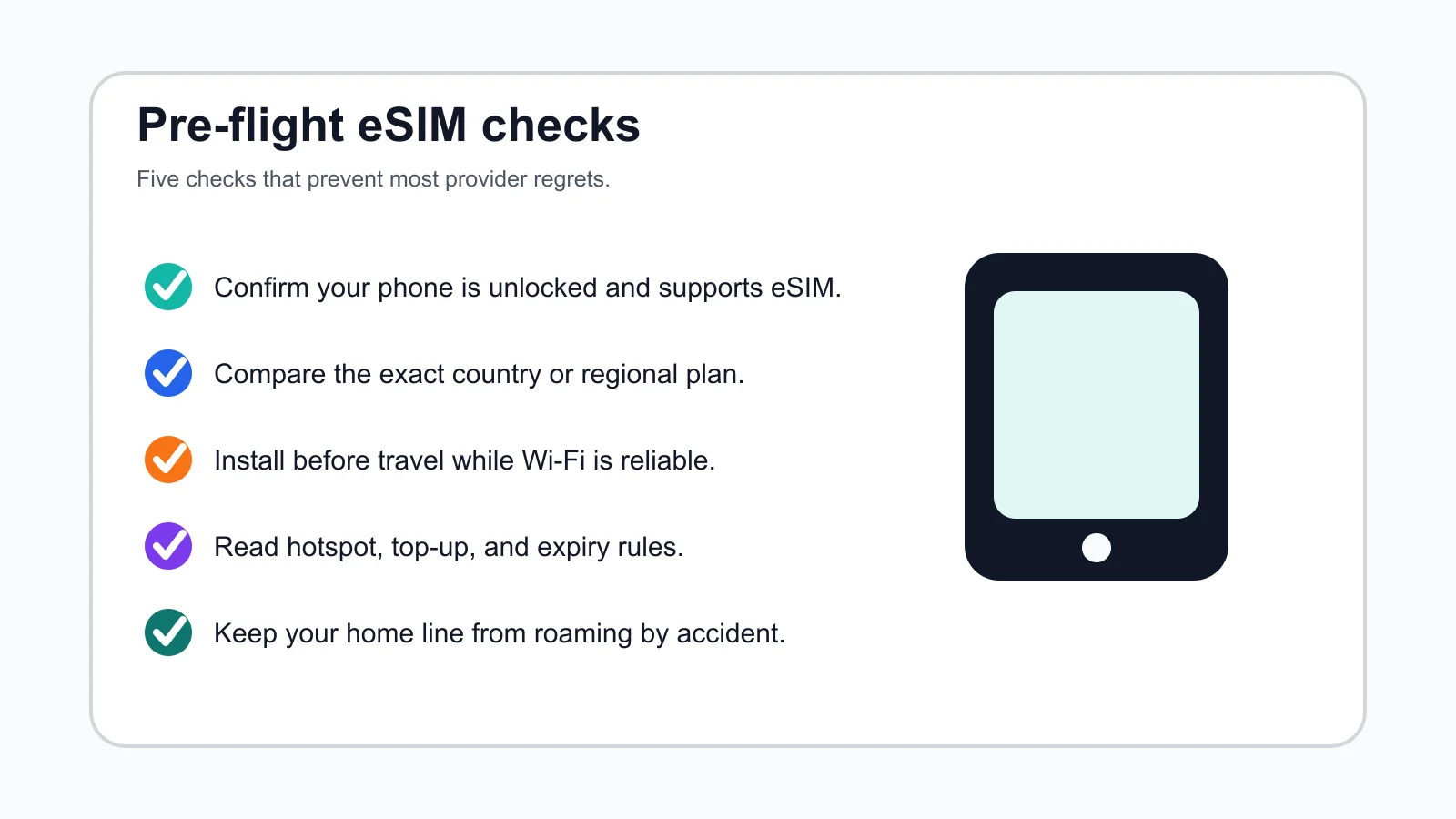
- Search the exact destination plan, not only airalo vs ubigi.
- Compare total trip data, validity, and price per useful GB.
- Check whether hotspot or tethering is allowed before relying on a laptop.
- Install the eSIM while you still have stable Wi-Fi.
- Keep your home line from roaming unless you intentionally need it active.
- Do not delete an eSIM profile until support confirms it is safe.
- Save screenshots of the plan, QR code, and setup instructions before departure.
Frequently Asked Questions
is ubigi better than airalo?
Ubigi can be better if you value a reusable profile, app-based top-ups, and support for more device types. Airalo can be better if you want a broad marketplace with lots of country and regional options. The right answer depends on the destination plan.
is airalo or ubigi better for japan?
Both are popular for Japan, but do not buy from reputation alone. Compare current Japan data sizes, validity, network language, top-up rules, and hotspot needs before choosing.
does ubigi work without wifi?
Ubigi says you need internet access to download the eSIM profile, and Android users may need Wi-Fi for new profile installs. After the profile is installed, top-up behavior depends on Ubigi's app and account flow.
can i use airalo and ubigi on the same phone?
Usually, yes, if your phone supports multiple eSIM profiles and is not carrier-locked. Only one or two lines may be active at once depending on the phone, so label each plan clearly.
which is cheaper airalo vs ubigi?
There is no permanent cheaper provider. Prices move by country, data size, validity, and promotions, so compare the exact plan you would buy today.
Bottom Line
The best way to settle airalo vs ubigi is to stop asking which brand is better and start asking which plan fits this trip. Airalo is often the easier marketplace pick. Ubigi is often the stronger reusable-profile pick. Your destination, data use, hotspot needs, and setup comfort decide the winner.
Official sources: Airalo Help Center · FAQ UBIGI vs AIRALO. Check current program pages before applying.