Destination eSIMs
Best Australia Travel eSIMs: What to Buy Before You Fly
Find the best esim for australia travel with plan picks for cities, road trips, hotspot use, setup, and local prepaid alternatives.

If you are looking for the best esim for australia travel, start with the shape of your trip, not the provider logo. A week in Sydney and Melbourne needs a different data plan than a campervan route, a remote-work stay, or a long visit where a local prepaid eSIM may be worth the ID check.
For most visitors, the cleanest buy is a travel eSIM you install before departure, use for maps and messaging after landing, and top up only if your route stretches longer than expected. Heavy hotspot users and month-long travelers should compare unlimited travel plans against Australian prepaid eSIMs before paying.
| What you see | Likely cause | First move |
|---|---|---|
| Cheap 1 GB or 3 GB plan | Built for backup data, not full-trip use | Price the 5 GB and 10 GB tiers too |
| Unlimited data looks expensive | You are paying for less tracking and fewer top-ups | Check hotspot sharing and fair-use rules |
| Local prepaid has much more data | Australian carriers can price domestic plans aggressively | Confirm ID checks and activation steps |
| No service outside major cities | Coverage depends on the local partner network | Check the route, not only the country name |
| eSIM installed but data will not load | Wrong data line, roaming toggle, or APN setting | Use Wi-Fi and fix settings before deleting it |
Quick Verdict for Australia Visitors
Pick Saily first if you want a simple app, fixed data choices, and an easy middle ground for normal city travel. Its Australia page lists small fixed-data plans as well as larger and unlimited options, which makes it a practical first check for travelers who do not want to overbuy.
Choose Holafly if you want unlimited data for a work-heavy or video-heavy trip and are comfortable paying more for convenience. Read the hotspot policy before assuming one unlimited plan will cover every laptop, tablet, or travel partner.
Keep Airalo and Nomad on the shortlist when you already use those apps or want a quick price check. Nomad's Australia page emphasizes 4G/5G travel data, add-ons, and prepaid control, while Airalo is useful when you prefer a familiar marketplace with local, regional, and global plan choices.
How to choose the best esim for australia travel

Start with the route. Sydney, Melbourne, Brisbane, Perth, Adelaide, and the Gold Coast are easy use cases because travel eSIM providers usually focus their strongest coverage language around major cities and tourist corridors.
Road trips need more caution. Australia has long stretches where any mobile service can thin out, so a provider that looks perfect in a city may not feel perfect between towns, in national parks, or deep inland.
For a short city break, 5 GB is a comfortable baseline if you use hotel Wi-Fi for updates and video. For one to two weeks, 10 GB is the safer normal pick. Move to 20 GB or unlimited if you plan to hotspot, stream, upload video, or work from your phone connection.
Provider Picks by Travel Style
Best first check for simple trips: Saily
Saily is the easiest first stop for travelers who want a clear plan ladder and do not need a local Australian number. It works best for visitors who mostly need maps, ride apps, messaging, restaurant searches, light social posting, and occasional browsing.
Its strongest fit is the middle of the market. You can buy enough data for a normal trip without jumping straight to unlimited, and you can still compare the unlimited option if you know your usage runs high.
Best for unlimited data: Holafly
Holafly makes sense when you hate watching a meter. Its Australia page positions the plan around unlimited data, 4G LTE and 5G where available, and Optus as the listed network partner.
That does not mean every use is unlimited in the way travelers imagine. Holafly describes hotspot sharing as a daily allowance, so check the current limit before relying on it for a laptop or a second phone.
Best price-check option: Nomad
Nomad is worth checking when you want prepaid data, add-ons, and a travel-app setup without local carrier paperwork. Its Australia page also reminds buyers that speed and coverage can vary by location and time of day, which is exactly the caveat travelers should keep in mind.
Use Nomad as a price check against Saily, Airalo, and Holafly. The best deal can change by data size, validity, sale timing, and whether you need a top-up.
Best familiar marketplace fallback: Airalo
Airalo is useful if you already have the app installed and want a quick country plan before boarding. It is also helpful when Australia is part of a bigger trip and you want to compare a local Australia eSIM against regional or global packages.
Do not stop at the brand name. Open the exact Australia plan, check validity, partner network notes, hotspot behavior, and top-up rules, then compare the total trip cost.
Travel eSIM or Local Australian Prepaid?
Buy a travel eSIM when you want the easiest landing. You can usually install before the flight, avoid the airport SIM counter, and get online as soon as the plan connects after arrival.
Consider local prepaid eSIM if you are staying for several weeks, need lots of domestic data, or want calls and texts included. Telstra, Optus, and other Australian providers can offer large prepaid inclusions, but activation is more involved than buying a travel eSIM app plan.
Here is the catch people miss: Australian prepaid mobile services require identity checks. The Australian Communications and Media Authority says telcos must collect details such as name, date of birth, and address, then check ID when activating a prepaid mobile service. That can be fine, but it is not the same frictionless purchase as a travel eSIM.
How Much Data Should You Buy?
Use 1 GB only as emergency backup, airport arrival data, or a very short stop. Maps, rideshare, web searches, and airline apps can eat through it quickly once you are moving.
Use 5 GB for a light city trip with reliable hotel Wi-Fi. That is enough for maps, messaging, transit checks, restaurant searches, and light photo sharing if you avoid streaming.
Use 10 GB for the safest normal vacation pick. It gives you room for navigation, social posting, browsing, translation, and a few hotspot sessions without paying unlimited rates.
Use 20 GB, unlimited, or local prepaid if you will work, stream, upload video, drive long distances, or share data with another device. Honestly, this is where most thin comparison pages get it wrong. They compare the cheapest plan, not the plan you will actually need.
Setup Checks Before Departure
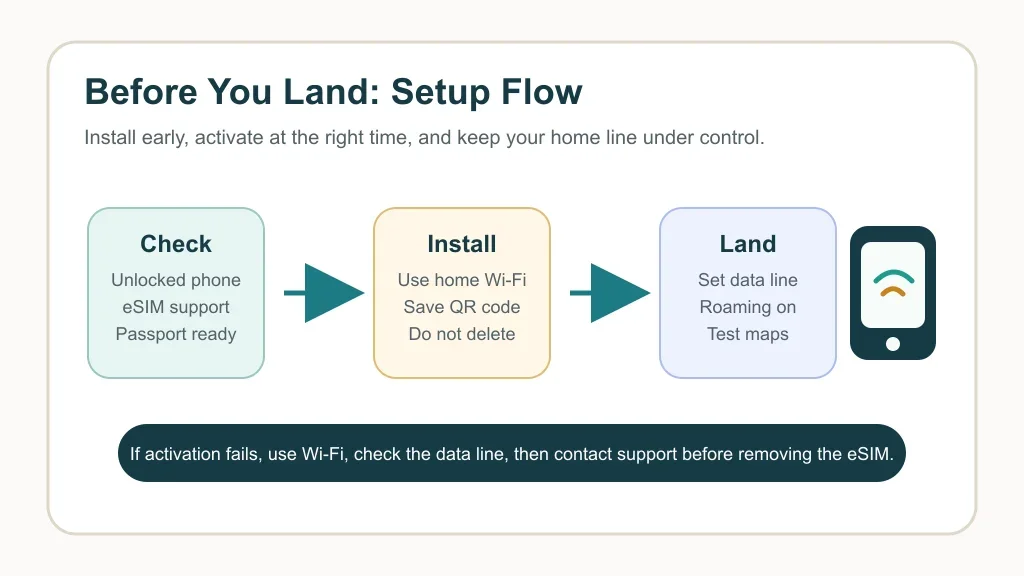
Confirm your phone is unlocked and supports eSIM. On many phones, dialing *#06# shows device identifiers; an EID usually signals eSIM support, though you should still check your model and carrier lock status.
Install the eSIM on stable Wi-Fi before your trip when the provider allows it. Then follow the provider's timing instructions, because some plans start validity at installation while others start when they first connect in Australia.
Keep your home SIM available if you need bank codes, airline texts, or your regular iMessage number. Set the travel eSIM as the cellular data line, keep home data roaming off unless you knowingly want to pay for it, and test maps before leaving the airport.
Need device help? Use TripESIMs guides on how to set up a travel eSIM on iPhone, whether an eSIM works without Wi-Fi, iPhone hotspot fixes, and how to move a travel eSIM to a new iPhone before your flight.
Australia Route Details That Change the Answer
City-only trips are the easiest. Sydney plus Melbourne, Brisbane plus the Gold Coast, or Perth plus Fremantle usually points toward a fixed-data travel eSIM unless you already know you need unlimited.
Nature-heavy routes are harder. Great Ocean Road, Tasmania, the Red Centre, Far North Queensland, national parks, and long campervan drives all make network partner coverage more important than a small price difference.
Multi-country travel changes the math too. If Australia is paired with Bali, Thailand, Southeast Asia, or a cruise, compare a regional plan before buying separate country plans. Start with the Bali travel eSIM guide, Thailand eSIM picks, Southeast Asia eSIM guide, and the cruise travel eSIM guide if your itinerary keeps moving.
Common Buying Mistakes
Buying by the lowest sticker price is the first mistake. A tiny plan can cost more once you top up twice, and an unlimited plan can be wasteful if your hotel Wi-Fi handles the heavy lifting.
Ignoring hotspot rules is the second. Capped-data plans often allow tethering because you are spending your own allowance, while unlimited plans may set sharing limits or fair-use thresholds.
Assuming every provider covers every remote stretch is the third. Australia is big, and a plan that feels excellent in Melbourne can still be weak on a rural highway or in a national park.
For broader comparison habits, read the Airalo vs Ubigi comparison, the guide to data-only eSIMs versus plans with a phone number, and when a travel eSIM with a phone number is worth the added complexity.
Quick Checklist
- Check that your phone is unlocked and eSIM-compatible.
- Choose 5 GB for light city travel, 10 GB for most vacations, and more for hotspot or work.
- Compare Saily, Holafly, Nomad, and Airalo on the exact Australia plan page.
- Read hotspot, fair-use, and top-up rules before buying unlimited data.
- Use local prepaid only if the ID check and activation steps make sense for your stay.
- Install on Wi-Fi before travel when the provider allows it.
- Save support instructions, QR codes, and purchase emails before boarding.
Official sources: For provider and setup checks, we used Holafly's official Australia eSIM page. For local prepaid identity rules, we used the ACMA page on ID checks for prepaid mobiles. Re-check plan pages before checkout because prices and terms can change.
Where to Go Next
If Australia is one stop in a bigger travel year, compare nearby and long-haul guides for Canada, the UK, Greece, Portugal, Spain, France, Italy, Morocco, and Iceland.
Frequently Asked Questions
which Australia travel eSIM is best?
For most city-focused visitors, Saily is the best first check because it gives clear fixed-data choices and simple app setup. Holafly is better if you want unlimited data, while Nomad and Airalo are useful price checks.
how much data do I need for Australia travel?
Plan on 5 GB for a light city trip and 10 GB for a safer one- to two-week vacation. Move to 20 GB, unlimited, or local prepaid if you will work, stream, hotspot, or travel for several weeks.
is Holafly good for Australia?
Holafly is a good fit if you want unlimited phone data and do not want to track every gigabyte. Check the current hotspot allowance and fair-use wording before relying on it as a shared laptop connection.
should I buy an Australia eSIM before arriving?
Yes, buying and installing before departure is usually easier. Follow the provider's activation timing so you do not start the validity clock too early.
can tourists get a local eSIM in Australia?
Often, yes, but local prepaid activation requires identity checks. Bring acceptable ID and verify the provider's process before assuming a local eSIM will be faster than a travel eSIM app.
does an Australia eSIM work in Tasmania?
Many Australia eSIM plans include Tasmania, but real-world service depends on the local partner network and your exact route. Check coverage carefully if you will drive outside major towns.
Australia is easy to overbuy for because the distances are huge and unlimited sounds comforting. Match the plan to your real route, install it before you need it, and keep local prepaid in reserve for long stays or heavy data use.