Travel Data
The Best eSIM for Business Travel, Without Roaming Drama
Pick the best esim for business travel with fewer roaming surprises: compare hotspot rules, coverage, activation timing, and backups.
Choosing the best esim for business travel is less about finding the cheapest gigabyte and more about avoiding the moment your laptop, maps, rideshare app, and two-factor login all need data at once. A good work-trip eSIM should cover the countries on your route, allow hotspot when you need it, install before departure, and give you a clean backup if a local partner network is weak.
Use the shortlist below as a buying filter. It is built for travelers who need calls to connect, files to upload, and calendar changes to load quickly, not for someone casually checking social media from a hotel lobby.
| What you see | Likely cause | First move |
|---|---|---|
| Phone has data, laptop has none | Hotspot is blocked, capped, or not enabled | Check tethering terms before buying |
| Signal drops between meetings | Plan depends on one weaker local network | Choose a provider with clear local carrier details |
| QR code will not activate at the gate | Phone needs Wi-Fi, unlock status, or manual setup | Install before departure and keep the QR email offline |
| Video calls stutter after heavy use | Fair-use speed limits or a small data pack | Buy more data than your meeting calendar suggests |
| Bank or work login asks for SMS | Data-only eSIM does not include a phone number | Keep your home line active for texts |
How to Choose the best esim for business travel
Start with your workday, then pick the plan. The best esim for business travel on a two-day London trip may be a small country plan with dependable 5G. The best esim for business travel across Germany, France, and Spain is usually a regional Europe plan because border crossings matter more than a low one-country price.
For client meetings, the deal-breakers are hotspot, activation reliability, and clear coverage. If the provider hides hotspot rules or only says “coverage varies,” keep comparing. You do not want to discover that detail five minutes before a screen share.
Provider Fit for Different Work Trips
Airalo, Nomad, Saily, Ubigi, and Holafly all make sense in different business-travel situations. Treat them as plan types rather than a single universal winner.
- Airalo: good for travelers who want lots of country and regional options, especially when they already know how much data they use.
- Nomad: useful for longer trips where a larger data bucket and straightforward top-ups matter.
- Saily: a strong fit when app simplicity and privacy-adjacent features are part of the buying decision.
- Ubigi: worth checking for laptop-heavy travelers and routes where local network details are easy to compare.
- Holafly: best considered when unlimited-style data is more valuable than paying only for a small bucket.
If your trip includes Australia, Canada, Southeast Asia, or several EU stops, compare destination pages before buying a global plan. Regional plans can be cleaner, but country plans sometimes offer better value and clearer network behavior.
Business Features That Matter More Than Price
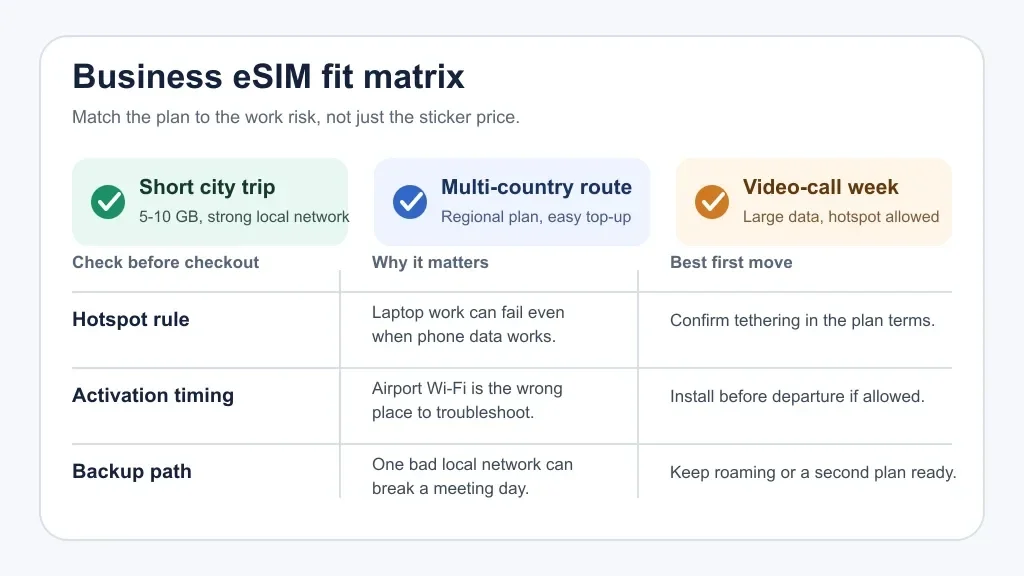
Hotspot should be your first filter. A phone-only plan is fine for maps and email, but business travelers often need to connect a laptop from a train, taxi, hotel lobby, or conference venue. For the best esim for business travel, hotspot terms deserve the same attention as data size.
Coverage transparency comes next. A provider that names partner networks, supported countries, and plan duration is easier to trust than a page that only says “global.” If you are visiting smaller cities, industrial parks, islands, or border regions, local carrier quality can decide whether the plan feels fast or frustrating.
Data Planning for Meetings, Maps, and Hotspot
A light business trip can survive on 3-5 GB if you use hotel Wi-Fi and only need email, maps, ride apps, and messaging. Add video calls, hotspot, cloud documents, or a second device and the safer range quickly moves toward 10-20 GB for a week.
Honestly, the cheapest plan is not always the smartest plan. Paying a little more for the best esim for business travel can save a roaming day pass, a missed call, or an awkward search for coffee-shop Wi-Fi. For high-stakes trips, carry a backup: your home carrier’s roaming toggle, a second eSIM option, or a small local SIM plan if your phone supports it.
Setup Checks Before You Fly
Confirm that your phone is unlocked and eSIM-compatible. Apple says recent iPhones can use eSIM for international travel, but setup still depends on carrier support, device model, region, and a Wi-Fi or hotspot connection for many activations. Android travelers should run the same check through their phone maker and carrier before buying.
Save the QR code or manual setup details somewhere you can access offline. If your company manages your phone, ask whether eSIM installation is restricted. That boring question can save a long airport support chat.
Where This Guide Fits with Other Trip Planning
Compare costs against international roaming before assuming an eSIM wins every trip. For provider matchups, see Holafly vs Nomad, Saily vs Airalo, and Airalo vs Ubigi.
Destination research matters too. Start with our guides for Australia travel eSIMs, Canada travel eSIMs, Greece travel eSIMs, Portugal travel eSIMs, Southeast Asia eSIMs, UK travel eSIMs, Morocco travel eSIMs, Spain travel eSIMs, France travel eSIMs, Italy travel eSIMs, and Bali travel eSIMs.
For setup edge cases, keep travel eSIMs with phone numbers, iPhone hotspot fixes, moving an eSIM to a new iPhone, and data-only versus phone-number eSIMs on your prep list. Cruise travelers should also read the cruise eSIM guide because ship days and port days work differently.
Quick Checklist
- Match the plan to every country on your itinerary, including layovers where you may need data.
- Confirm hotspot is allowed if you need laptop access.
- Check whether the plan is data-only or includes a phone number.
- Install the eSIM before departure when the provider permits it.
- Keep your home line available for SMS codes and emergency roaming.
- Buy enough data for video calls, map use, cloud files, and delays.
- Save QR codes, manual setup steps, and support links offline.
For most work trips, the best esim for business travel is the one that reduces failure points: enough data, clear hotspot rules, reliable destination coverage, and a backup path. That is the real test for the best esim for business travel. Pick from that checklist first, then compare price.
Official sources: Apple Support: Use eSIM while traveling internationally with your iPhone · Holafly: Buy eSIM for International Travel.
Frequently Asked Questions
what is the best esim for business travel?
The best esim for business travel is usually a plan with verified destination coverage, hotspot support, enough data for meetings, and easy support if activation fails. The provider can change by route.
do business travelers need unlimited eSIM data?
Not always. Unlimited-style plans help if you hotspot a laptop or join video calls often, but a clear 10-20 GB plan may be enough for a short, Wi-Fi-supported trip.
can I use a travel eSIM for laptop hotspot?
Sometimes. Many plans allow hotspot, some limit it, and a few block it. Check the plan terms before buying if laptop data is part of your workday.
should I install my business travel eSIM before flying?
Yes, if the provider allows pre-installation without starting the plan too early. Install at home on stable Wi-Fi, then activate according to the provider’s timing rules.
will a data-only eSIM receive work verification texts?
No. A data-only travel eSIM will not receive normal SMS messages. Keep your regular line available if your workplace, bank, or airline sends text codes.