Destination eSIMs
The Smartest eSIM Picks for a Multi-Country Europe Trip
Find the best esim for multi country europe with route-based picks, data-size rules, setup checks, hotspot notes, and source links.

If you are trying to find the best esim for multi country europe, start with your route, not a provider logo. A Paris-to-Amsterdam weekend, a four-country rail pass trip, and a month of remote work across Portugal, Spain, and Italy need different data plans.
Europe eSIM shopping looks simple until you hit the details: country lists, hotspot rules, fair-use limits, activation windows, and whether the plan is data-only. Get those right and one regional eSIM can be much easier than juggling local SIM cards at every border.
| What you see | Likely cause | First move |
|---|---|---|
| A cheap 1 GB Europe plan | Low entry price, not enough for maps and daily use | Use it as backup or for a short city break only |
| Unlimited data headline | May include daily high-speed caps or fair-use throttling | Read the speed and hotspot notes before buying |
| Plan says Europe but misses one stop | Regional country lists differ by provider | Check every country, including Switzerland, Turkey, and islands |
| Phone number included nowhere | Most travel eSIMs are data-only | Use internet calling apps or choose a provider with voice/SMS |
| eSIM will not activate at home | Some plans activate only on a supported destination network | Install first, then turn on the line after arrival |
Best eSIM for Multi Country Europe: Quick Buying Rules
Choose a regional Europe plan when your trip crosses borders in a week or two. It keeps the phone setup simple, gives you one data bucket to watch, and avoids buying a new plan whenever a train crosses into another country.
Pick a local country eSIM only when one country dominates the trip. Two weeks in Italy with a one-day side trip to Switzerland is not the same as a London, Paris, Amsterdam, Berlin, Prague loop.
Watch the outliers. Switzerland, Turkey, the UK, Iceland, Norway, and island destinations can be included on one Europe plan and missing on another. Saily's current Europe page, for example, lists 35 covered countries and shows plan sizes from 1 GB through 50 GB plus unlimited-style options. Airalo's Europe page is also a useful official source candidate because it is a provider page built around Europe-wide coverage.
Start With the Route Shape
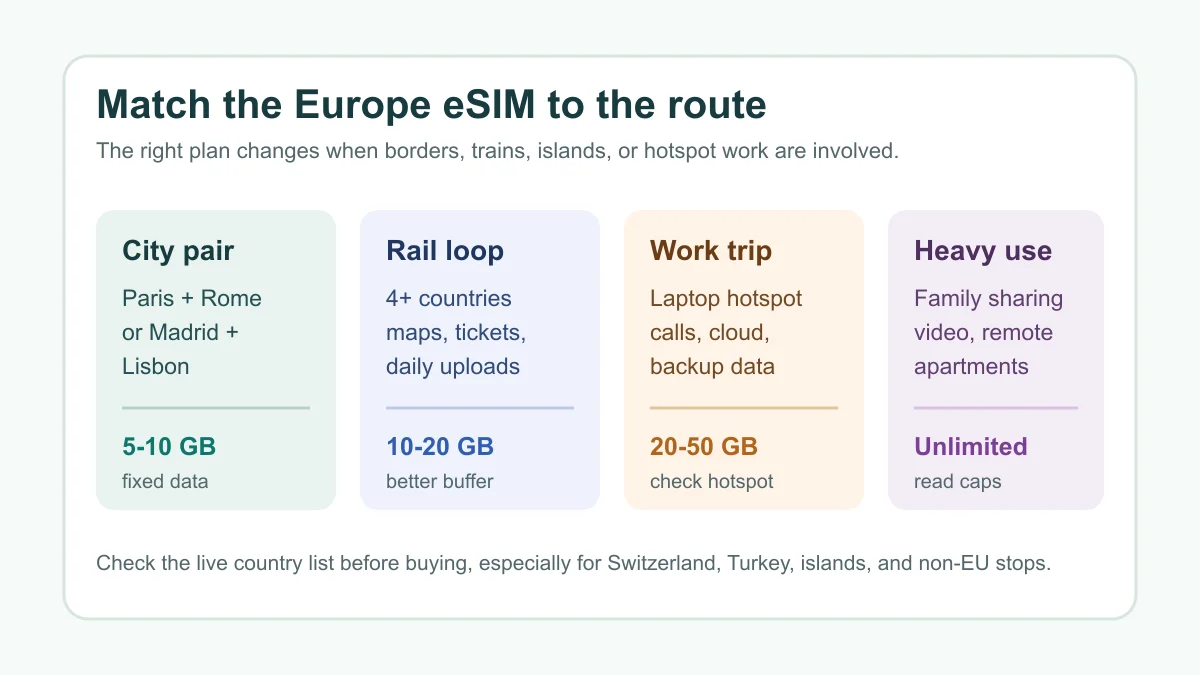
A city-pair itinerary is the easiest case. If you land in Paris, take a train to Amsterdam, and fly home four days later, a small regional plan can be enough if you mostly need maps, messaging, ride apps, and tickets.
A rail loop needs more room. Moving between four or five countries usually means more navigation, more ticket apps, more hotel check-ins, and more time away from reliable Wi-Fi. That is where 10 GB to 20 GB starts to feel less like a luxury and more like a buffer.
A work trip changes the decision again. If you need hotspot for a laptop, cloud documents, video calls, or backup data in apartment rentals, the headline data amount is only half the question. Hotspot permission, daily high-speed caps, and top-up rules matter just as much.
How Much Data to Buy
Light travelers can often manage with 5 GB to 10 GB for a week or two if they use hotel Wi-Fi and avoid streaming. That covers maps, train apps, translation, messaging, restaurant searches, boarding passes, and light photo uploads.
Average travelers should lean toward 10 GB to 20 GB when the price jump is reasonable. You will not have to think about every Google Maps route, every WhatsApp call, or every delayed train day.
Heavy users should look at 20 GB, 50 GB, or unlimited-style plans. Families, digital nomads, and people staying in rentals with unreliable Wi-Fi need more than a pretty checkout price. They need predictable hotspot behavior.
Provider Fit: Airalo, Saily, Nomad, Holafly, and Ubigi
Airalo is a common first stop for regional Europe plans because it is easy to compare local, regional, and global options. It can fit travelers who want fixed data, straightforward app setup, and a familiar marketplace-style buying flow.
Saily is worth comparing when you want a broad Europe plan with flexible data sizes and app-first setup. Its official Europe page currently lists data-only service, 35 covered countries, hotspot sharing, top-ups, and an activation flow that starts when you arrive in an included country.
Nomad often competes well for fixed-data regional plans. It is a good shortlist option when you want a simple data bucket and clear plan duration, but still check the country list and speed notes against your actual route.
Holafly is the provider many travelers compare when they want unlimited-style data. That can be useful for heavy phone use, but read the hotspot and fair-use terms carefully because unlimited does not always mean unlimited full-speed sharing.
Ubigi can be useful for travelers who care about tethering, tablets, laptops, or connected devices. Compare it when your trip is more about working across borders than casual tourist data.
Coverage Details People Miss
Country coverage is not the same thing as strong coverage everywhere inside that country. A plan can include Greece and still vary between Athens, the islands, ferry routes, and mountain villages because local network partners and terrain matter.
Border days are the stress test. If you will cross from France into Switzerland, Spain into Portugal, or Austria into Hungary by train, check that both sides are included before the trip begins.
Cruises are a separate category. A normal Europe eSIM works on land through supported mobile networks, not in the middle of the sea. If your route includes ports, read our eSIM or international roaming cost guide and the business travel eSIM guide before assuming one plan covers everything.
Setup Checks Before You Fly
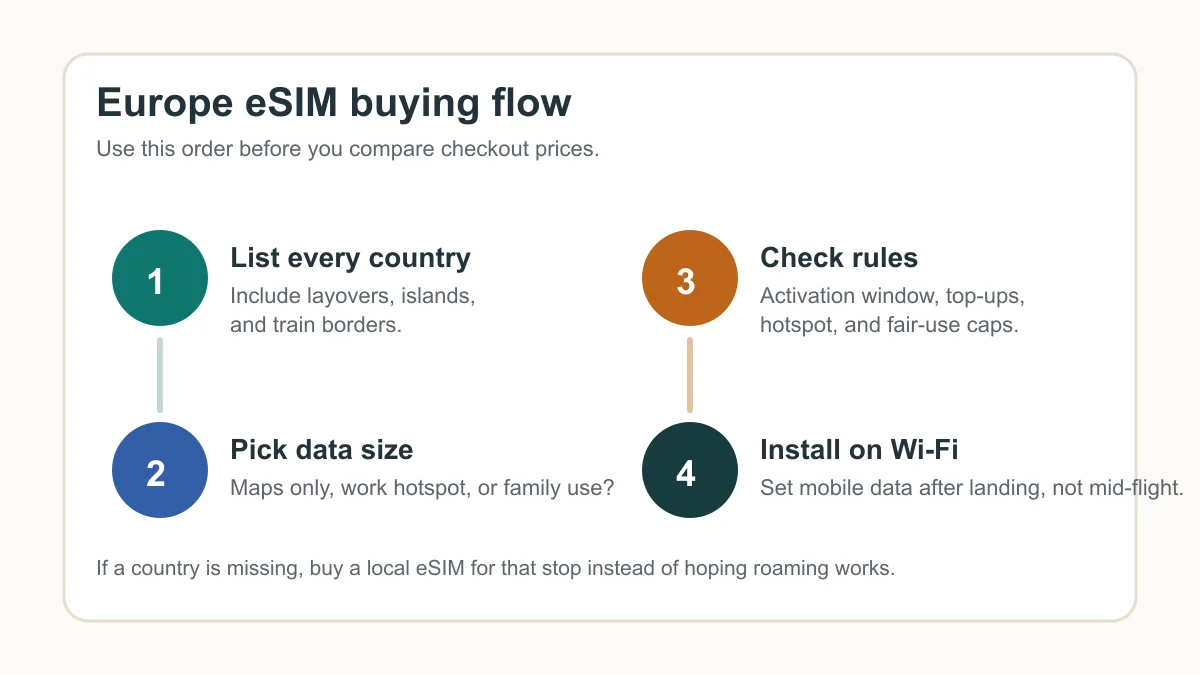
Install the eSIM while you have reliable Wi-Fi. Apple says iPhone travelers need an iPhone XS, XR, or later, a supporting carrier or worldwide provider, and in most cases Wi-Fi or a hotspot for setup. The same practical rule applies to Android travelers: do not leave installation for an airport arrivals hall.
Keep your home SIM quiet. Many travelers leave their home number on for banking texts and calls, then set mobile data to the travel eSIM. If your home carrier data roaming stays on, the roaming bill can still happen.
Do not delete the eSIM profile while troubleshooting. Some travel eSIMs can be reissued easily, others cannot. Start with airplane mode, restart, manual network selection, APN instructions, and provider support.
For phone-specific help, keep these nearby: travel eSIM with a phone number, iPhone eSIM hotspot fixes, moving a travel eSIM to a new iPhone, and data-only eSIM or phone number.
Data-Only Plans, Calls, and Hotspot Rules
Assume the plan is data-only unless the provider clearly says otherwise. That is fine for most travelers because WhatsApp, FaceTime, Signal, Messenger, Google Voice, and airline apps work over mobile data.
Need a normal phone number? Look for a local carrier SIM, an eSIM that explicitly includes voice/SMS, or a separate internet-calling setup. Do not buy a generic data eSIM and expect hotel desks, restaurants, or banks to text a new local number.
Hotspot is the quiet deal-breaker. A plan can be perfect for phone use and still poor for a laptop if tethering is restricted or the high-speed allowance resets daily. Read that section before you build a workday around it.
When a Regional Plan Beats Roaming
Carrier roaming passes are convenient when your home plan already includes Europe or when your trip is too short to justify comparing providers. Still, daily passes can add up quickly on a two-week itinerary.
A regional eSIM usually wins when you want predictable prepaid data and do not need your home carrier for everything. The tradeoff is that you must install and manage one more line.
Want destination-specific comparisons before committing? Read our guides to UK travel eSIMs, Greece travel eSIMs, Portugal travel eSIMs, Spain travel eSIMs, France travel eSIMs, and Morocco travel eSIMs.
Use Comparisons, Then Buy From the Live Page
Provider comparisons are useful, but they age fast. Start with matchups such as Saily vs Airalo, Holafly vs Nomad, Airalo vs Ubigi, and Airalo vs aloSIM, then confirm prices and rules on the official checkout page.
Longer trips need a backup mindset. If you are traveling onward after Europe, compare our Southeast Asia eSIM guide, Australia eSIM guide, Canada travel eSIM guide, and cheap Japan travel eSIM guide so you know when to switch from regional to local plans.
Quick Checklist
- Write down every country on the route, including layovers, islands, and border crossings.
- Choose regional Europe coverage for true multi-country trips, local eSIMs for one-country stays.
- Buy 5 GB to 10 GB for light use, 10 GB to 20 GB for most rail trips, and more for hotspot work.
- Check hotspot, fair-use, top-up, refund, and activation-window rules on the live provider page.
- Confirm your phone is unlocked and eSIM-compatible before paying.
- Install on Wi-Fi before departure, then set mobile data after arrival if required.
- Keep your home SIM from using data roaming unless you intentionally want carrier roaming.
Bottom line: the right Europe eSIM is the one that matches your route, data habits, and tolerance for setup. For most multi-country vacations, a regional fixed-data plan with clear country coverage is the cleanest buy. For work, families, or heavy hotspot use, spend more time reading the rules than chasing the lowest headline price.
Official sources: Airalo Europe eSIM plan page · Apple Support eSIM travel guidance.
Frequently Asked Questions
what is the best esim for multiple countries in europe
For most travelers, the best choice is a regional Europe eSIM with enough data for the whole route, clear country coverage, hotspot support if you need it, and an activation window that matches your travel dates.
is a europe esim better than buying local sims
A Europe eSIM is usually easier for short multi-country trips because one profile can cover several borders. Local SIMs can still make sense for long stays in one country, heavy voice/SMS needs, or travelers who want a local number.
how much data do i need for two weeks in europe
Light users can often manage with 5 GB to 10 GB for maps, messaging, and tickets. Choose 20 GB or more if you use hotspot, upload photos daily, stream video, or work from your phone.
do europe esim plans include calls and texts
Most travel eSIM plans are data-only. Calls and messages usually run through apps such as WhatsApp, FaceTime, Signal, or Messenger unless the provider explicitly sells a phone number or voice/SMS plan.
should i install my europe esim before flying
Yes. Install it on reliable Wi-Fi before departure, then activate mobile data after arrival if the provider tells you to wait. Do not delete the profile while troubleshooting unless support confirms it can be reissued.